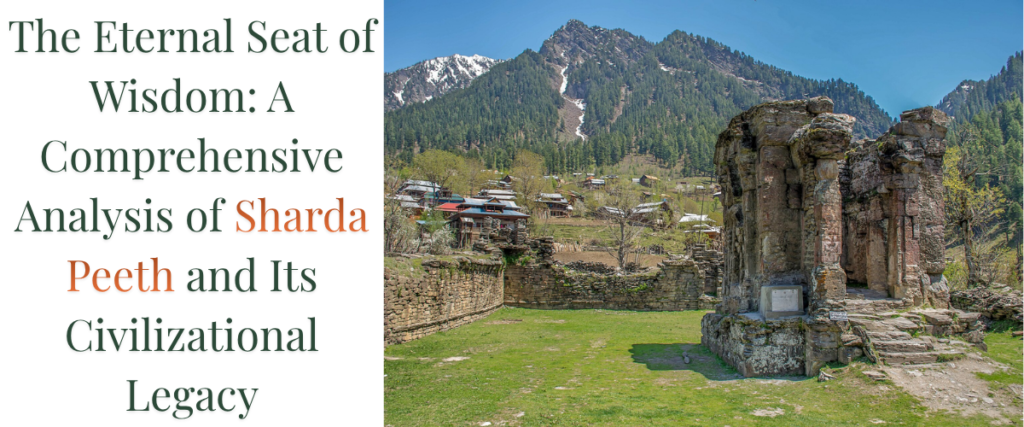
The mist-laden peaks of the Neelum Valley, situated in the upper reaches of the disputed Kashmir region, guard the crumbling remains of what was once the intellectual heart of the Indian subcontinent. Sharda Peeth, also known as Sharada Peeth, stands as a profound testament to the historical synthesis of spirituality, academic rigour, and architectural brilliance.1 Located in Pakistan-occupied Kashmir (PoK), approximately 10 kilometres from the Line of Control (LoC), this ancient site was once an institution on par with the legendary universities of Nalanda and Takshila.3 For the Kashmiri Pandit community, it remains the ultimate symbol of their cultural identity, serving as one of the three holiest pilgrimage sites alongside the Martand Sun Temple and the Amarnath cave.1
The geography of Sharda Peeth is as spiritually significant as its history. It rests at the confluence of three ancient rivers—the Kishanganga (known as the Neelum in Pakistan), the Madhumati, and the Sargun.6 This convergence, framed by the shadow of Mount Harmukh, was believed to be the residence of the goddess herself.7 Today, the ruins of the temple and university are at a critical crossroads of heritage preservation, religious longing, and geopolitical tension. The site represents a “lost glory” that continues to influence the linguistic and religious traditions of the entire South Asian region, from the high Himalayas to the southernmost tips of the Indian peninsula.9
The Mythological Foundations of the Seat of Wisdom
The origins of Sharda Peeth are deeply embedded in the Puranic traditions of Hinduism, particularly the story of the Maha Shakti Peethas. According to the foundational myth, the goddess Sati, the embodiment of Shakti, immolated herself following the disrespect shown to her husband, Lord Shiva, by her father, King Daksha.11 In a state of divine grief and rage, Lord Shiva performed the Tandava, the cosmic dance of destruction, while carrying Sati’s lifeless body.2 To prevent the annihilation of the universe, Lord Vishnu used his Sudarshan Chakra to sever Sati’s body into pieces, which fell at various locations across the subcontinent.2 Sharda Peeth is revered as the spot where Sati’s right hand fell, marking it as one of the 18 most sacred Maha Shakti Peethas.1
Beyond the Shakti tradition, the site is dedicated to Goddess Sharada, the Kashmiri manifestation of Saraswati, the deity of knowledge, music, and wisdom.5 Local legends suggest a direct link between the physical environment and the divine. One account details the journey of the sage Shandilya, who performed intense tapasya (austerities) at Mount Harmukh to seek a vision of the goddess.10 According to the Sharada Mahatmya, Shandilya was guided to the Sharada forest, where the goddess appeared to him in her triple form as Sharada, Saraswati, and Vagdevi.1 During a ritual, the water he drew from the Mahasindhu was partially transformed into honey, creating the Madhumati stream that flows by the temple today.1
Another potent legend identifies the site as the location where the “Pot of Knowledge” was hidden. During a celestial conflict between the Devas (gods) and Asuras (demons), the goddess Saraswati intervened to protect the essence of prosperity and wisdom by burying the vessel beneath the ground where the temple now stands.2 This myth underscores why the region was historically referred to as Sharada Desh (the Country of Sharada) or Sarvajna Peetha (the Seat of All Knowledge).7
The significance of the 18 Maha Shakti Peethas is unparalleled in Hindu theology, as they represent the physical manifestations of divine energy across the landscape of Akhand Bharat. Sharda Peeth holds a unique position in this spiritual geography, often paired with other prominent sites to illustrate the reach of the Goddess’s influence.
Comparison of Key Maha Shakti Peethas and Their Attributes
| Peetha Name | Location | Goddess Form | Body Part / Attribute |
| Sharda Peeth | Neelum Valley, PoK | Sharada / Saraswati | Right Hand 1 |
| Kamakshi Amman | Kanchipuram, Tamil Nadu | Kamakshi | Navel 12 |
| Kamakhya Temple | Guwahati, Assam | Kamakhya | Womb 14 |
| Mahalakshmi | Kolhapur, Maharashtra | Ambabai | Left Eye 14 |
| Jwalamukhi | Kangra, Himachal Pradesh | Jwalamukhi | Tongue 11 |
| Chamundeshwari | Mysore, Karnataka | Chamunda | Hair 12 |
| Bhramaramba | Srisailam, Andhra Pradesh | Bhramarambika | Neck 11 |
11
This spiritual network demonstrates that Sharda Peeth was never a localised shrine but a vital node in a pan-Indian consciousness. The belief that the right hand of the goddess fell here is particularly evocative; the hand is the instrument of writing, the medium through which knowledge is recorded and transmitted. This alignment between the mythological “falling of the hand” and the historical “emergence of the script” provides a rare example of how religious symbolism can mirror cultural and intellectual reality.
Historical Evolution: From Ancient Foundations to Medieval Prominence
The historical trajectory of Sharda Peeth is marked by periods of immense intellectual prosperity followed by systemic decline. While its earliest mention appears in the Nilamata Purana (dated between the 6th and 8th centuries CE), historians suggest that the site’s significance as a centre of learning predates these records.1 Some scholars posit that the foundations of the university were laid during the Kushan Empire in the 1st century CE, a period when Kashmir served as a hub for the synthesis of Buddhist and Hindu philosophies.2
The zenith of Sharda Peeth’s architectural and political influence is widely attributed to the 8th-century monarch Lalitaditya Muktapida of the Karkota dynasty.1 Lalitaditya, a conqueror who expanded the borders of the Kashmiri kingdom, was a prolific builder of temples, including the famous Martand Sun Temple.1 Although no definitive inscription confirms his patronage of Sharda, the stylistic similarities between Sharda Peeth and other 8th-century Kashmiri structures strongly support this connection.1 During this era, Temple University attracted thousands of scholars, including students from as far as Bengal and Central Asia.1
By the 11th century, the site had achieved such renown that it was chronicled by the Persian polymath Al-Biruni. In his Indica, Al-Biruni did not categorise Sharda merely as a regional shrine but listed it alongside the most famous Hindu temples in the entire subcontinent, such as the Somnath Temple and the Multan Sun Temple.1 This historical recognition highlights that the “Peeth” was a pan-Indian institution, transcending the geographical barriers of the Himalayas.
The site also survived various political transitions. Jonaraja, a 15th-century historian, describes a visit by the Kashmiri Sultan Zain-ul-Abidin in 1422 CE.1 Despite being a Muslim ruler, the Sultan visited the temple seeking a divine vision, illustrating the syncretic “Ganga-Jamuni tehzeeb” (composite culture) that characterised medieval Kashmir.1 In the 16th century, Abu’l-Fazl, the Grand Vizier of Mughal Emperor Akbar, described the stone temple as a place of great veneration, noting a popular belief that the structure would miraculously shake on specific holy days.1
Historical accounts of the site often highlight the transformative power of the shrine. The travelogues of various eras present a narrative of a place that commanded respect from kings and commoners alike.
Key Historical Milestones of Sharda Peeth
| Era | Notable Event / Figure | Significance |
| 1st Century CE | Possible Kushan construction | Early identification as a Buddhist and Hindu centre 2 |
| 6th–8th Century | Nilamata Purana mentions | First recorded literary reference to the shrine 1 |
| 724–760 CE | Reign of Lalitaditya Muktapida | Potential construction of the current stone structure 1 |
| 632 CE | Visit of Xuanzang | Documentation of Kashmiri scholars’ intellectual brilliance 5 |
| 11th Century | Chronicle of Al-Biruni | Listed as one of the four most famous temples in India 1 |
| 1422 CE | Visit of Sultan Zain-ul-Abidin | Demonstration of the site’s cross-religious veneration 1 |
| 16th Century | Abu’l-Fazl’s Ain-i-Akbari | Recorded the temple as a “stone temple of great veneration” 1 |
| 1870 CE | Visit of Charles Bates | Noted the missing roof and deteriorating state 5 |
1
This timeline illustrates that for over a millennium, Sharda Peeth remained a constant in the fluctuating political landscape of Northern India. Its survival through successive dynasties—from the Karkotas to the Mughals—testifies to its deeply ingrained sanctity. However, the shift from a royal-patronised university to an “abandoned” ruin in the modern era marks one of the most significant cultural losses in Asian history.
The University of Sharda and the Intellectual Ecosystem
At its height between the 6th and 12th centuries, the Sharda Peeth functioned as a premier residential university. It is estimated to have housed over 5,000 resident scholars and featured one of the largest libraries in the ancient world.3 The curriculum was remarkably diverse, encompassing both religious and secular fields of study. Unlike many other ancient institutions that specialised in a single dogma, Sharda was known for its “Sarvajna” (all-knowing) nature, attracting diverse thinkers.
The university played a pivotal role in the dissemination of the Sharada script, an ancient writing system that evolved from the Western branch of Brahmi around the 8th century.17 This script became the primary medium for writing Sanskrit and Kashmiri, and its influence spread across North India, the Punjab, Himachal Pradesh, and even parts of Afghanistan.17 The scripts used in modern Tibetan and even the Gurmukhi script are believed to have genealogical links to the intellectual ecosystem of Sharda.3
The library at Sharda was so prestigious that it was considered the ultimate authority for validating scholarly work. A famous anecdote involves the philosopher Ramanujacharya, who travelled from South India to Sharda Peeth specifically to consult the Bodhayana Vritti, a rare manuscript essential for his commentary on the Brahma Sutras.9 This long-distance pilgrimage by one of India’s most influential thinkers underscores the library’s role as a unique repository of human knowledge.
The academic environment at Sharda Peeth was defined by rigorous debate. The architecture itself mirrored this intellectual openness; the temple famously possessed four doors facing the cardinal directions, each representing a gateway of knowledge from different parts of the subcontinent.9
The Intellectual Hierarchy and Curriculum of Sharda University
| Academic Level | Focus Area | Key Text / Tradition |
| Grammar (Vyakarana) | The foundation of all Sanskrit learning | Ashtadhyayi of Panini 9 |
| Philosophy (Darshana) | Advaita Vedanta and Trika Shaivism | Pratyabhijna school (Utpaladeva) 1 |
| Mathematics/Astronomy | Siddhantic calculations | Vatesvara-siddhanta (904 AD) 1 |
| Tibetan Linguistics | Developing new writing systems | Tibetan script (Thonmi Sambhota) 3 |
| Religious Studies | Vedas, Puranas, and Tantric texts | Nilamata Purana 1 |
1
The university’s pedagogical model emphasised the “Purvapaksha” and “Uttarpaksha” method—the presentation of an opponent’s view followed by its logical refutation. This culture of scepticism and inquiry is what allowed it to remain relevant even as religious tides shifted between Buddhism and Shaivism in the Kashmir Valley. Scholars such as Utpaladeva (c. 900–950 CE) contributed significantly to the Monistic Idealism of the Pratyabhijna school, which emerged from the intellectual ferment of this region.1 The institution was also a pioneer in mathematics; Vatesvara presented several trigonometric identities and astronomical theories here in the early 10th century, which remain foundational to Indian applied mathematics.1
Notable Scholars and the Legacy of Adi Shankara
The history of Sharda Peeth is inextricably linked with some of the most prominent intellectuals in Asian history. These figures not only studied at the university but also engaged in the intense philosophical debates that were a hallmark of the institution.
The most celebrated event in the temple’s history is the visit of Adi Shankaracharya in the 8th century. Shankara, a native of Kerala in South India, travelled the length of the country to challenge the scholars at Sharda.1 Legend has it that the “Southern Door” of the temple had never been opened by a scholar from the South.1 Shankara faced a series of challenges not just from philosophers, but reportedly from the Goddess Sharada herself, who questioned his purity and right to sit on the Sarvajna Peetha (Throne of Omniscience).1 After successfully defending his views and his character, he was permitted to ascend the throne, symbolising the integration of the diverse philosophical traditions of India under the umbrella of Advaita Vedanta.7
The scholars associated with Sharda Peeth were not limited to the Hindu tradition. The site was a melting pot of North Asian intellectualism.
- Kumarajiva: A 4th-century Buddhist scholar and translator whose work in Central Asia and China was foundational to the spread of Mahayana Buddhism. He is often cited among the scholars who engaged with the Kashmiri academic tradition.3
- Vairotsana: A primary translator in the first wave of Buddhism in Tibet, who sought the linguistic expertise of the Sharda masters to translate Sanskrit texts into the emerging Tibetan language.3
- Kalhana: The author of Rajatarangini, the first systematic history of India. His connection to Sharda reflects the institution’s role in preserving not just spiritual but historical and civic records.1
- Panini: Some traditions believe that the “father of Sanskrit grammar” composed or refined his Ashtadhyayi in the vicinity of Sharda, taking advantage of the region’s linguistic purity.9
This intellectual diversity suggests that Sharda Peeth was more than a temple; it was a “think tank” of antiquity. Its scholars were not merely repeating ancient verses but were active creators of new knowledge systems that would go on to define the cultures of Tibet, China, and the rest of India for centuries.
Architectural Synthesis: The Kashmiri School of Design
The physical remains of Sharda Peeth provide an invaluable window into the Kashmiri School of Hindu Architecture, which flourished between the 6th and 13th centuries.5 The temple is constructed primarily of local reddish sandstone, granite, and marble, exhibiting a massive masonry style that relies on the precise interlocking of large stone blocks—some measuring up to 2.1 x 1.2 meters—without extensive mortar.5
The architectural style is often described as “Classical Kashmiri,” characterised by a unique blend of indigenous design and Hellenistic influences.5 This Grecian influence, likely inherited from the Indo-Greek and Bactrian presence in the region centuries earlier, is visible in the fluted columns and Doric-style pediments.5
Technical and Structural Dimensions of the Sharda Ruins
| Feature | Description / Measurement |
| Material Composition | Reddish Sandstone, local Mountain Granite, and Marble 5 |
| Structural Plan | Square Cella on a high, square plinth 5 |
| Temple Enclosure Length | 142 feet 5 |
| Temple Enclosure Width | 94.6 feet 5 |
| Total Site Area | Approximately 4 kanals (~0.5 acres) 5 |
| Staircase Steps | 63 stone slab stairs, each approx. 8 feet wide 5 |
| Sanctum Wall Height | False arches reaching 6 meters in height 5 |
| Masonry Style | Trabeated architecture with trefoil (three-lobed) arches 5 |
The temple’s north-facing entrance is its most impressive remaining feature, adorned with trefoil details in the Arian style.5 These trefoil arches are a hallmark of Kashmiri architecture, also seen at the Sun Temple of Martand and the Avantipur ruins.5 The use of pyramidal roofs, though no longer present at Sharda, was once the defining silhouette of these Himalayan structures, designed specifically to shed the heavy winter snows of the Neelum Valley.7
Modern heritage observers emphasise the “sophisticated building techniques” employed at the site, such as corbelled arches and the strategic integration of timber elements as seismic dampeners.20 This advanced engineering explains why the foundational structures remain robust even after centuries of neglect and exposure to the harsh mountain climate. However, the loss of the roof—noted by Charles Bates in 1870—has accelerated the internal decay of the sanctum, leaving the “false arches” and fluted pillars vulnerable to the elements.5
The Tragedy of 1947 and the Geopolitical Divide
The decline of Sharda Peeth as a living religious site began long before the 20th century, but the events of 1947 sealed its fate as an inaccessible ruin. Following the Partition of India and the subsequent tribal invasion by raiders from Pakistan, the Neelum Valley became a part of Pakistan-administered Azad Kashmir.21 The Line of Control (LoC) was drawn just a few kilometres away from the temple, effectively severing the link between the shrine and the Kashmiri Pandit community that had worshipped there for millennia.16
For decades, the temple fell into a state of deep neglect. Because it was located in a highly sensitive military zone, access for pilgrims from India was completely blocked.21 The displacement of the Kashmiri Pandits from the Valley in the early 1990s further marginalised the shrine’s significance, as the primary community responsible for its upkeep was no longer in the vicinity.20
The site also suffered physical damage during the 1947 conflict. Reports suggest that the ancient temple and an adjoining Sikh Gurudwara were burnt down during the tribal raids.22 Over time, the lack of professional conservation work, environmental wear, and regional instability has led to the collapse of several structural sections.20 The site transitioned from being a “Temple of Wisdom” to a “Strategic Outpost,” with the surrounding plateau frequently used for military purposes.
The Impact of Modern Conflict on Sharda Peeth
| Period | Event | Impact on the Shrine |
| 1947–1948 | Tribal Raiders’ Invasion | Destruction of the adjoining Gurudwara and damage to temple precincts 22 |
| Post-1948 | Establishment of LoC | Complete cessation of formal pilgrimage from the Indian side 16 |
| 1990s | Displacement of Pandits | Loss of the local “custodian” community for the Sharda tradition 20 |
| 2005 | Kashmir Earthquake | Potential structural shifts, exacerbated by a lack of subsequent restoration 20 |
| 2023 | Military Construction | Erection of a “Coffee Home” inside the temple premises 7 |
7
The transformation of the site into a “forbidden zone” for its traditional worshippers is one of the most painful aspects of the Kashmir conflict for the Pandit community. For them, Sharda Peeth is not just an archaeological site; it is a “living memory” of their lost homeland. The inability to visit the shrine has led to a “ritualised longing,” where some sects of Brahmins in South India still perform a ritual of moving seven steps towards the North (Kashmir) during their initiation ceremonies as a symbolic gesture of seeking knowledge from Sharda Peeth.1
Current Status and Recent Conservation Efforts (2023–2025)
As of early 2026, the status of Sharda Peeth remains a subject of intense debate and concern among heritage advocates. Reports from 2023 and 2024 highlighted significant threats to the site’s integrity. The “Save Sharda Committee Kashmir” (SSCK), led by founder Ravinder Pandita, has frequently raised alarms about encroachments within the temple premises.23 One notable controversy involved the construction of a “Coffee Home” for soldiers by the Pakistan Army within the sensitive archaeological zone.8 This action was condemned by various international foundations as a violation of a Supreme Court order in PoK that had favoured the protection of the site.7
Despite these challenges, there have been recent indications of a shift in the local management of the site. In October 2024, the Tourism and Archaeology Department of Pakistan-occupied Kashmir announced that a protection project for the temple had been included in the annual development program for the 2024–2025 fiscal year.27 This proposal seeks to implement measures to safeguard the remaining structures and improve the rugged approach roads that currently hinder visitors.27
Summary of Conservation Status (2024–2025)
| Category | Observation | Current Challenge |
| Structural Health | Severe decay and stone erosion 21 | Lack of professional stonemasons for restoration |
| Artifact Status | Missing Seri Chakra and internal icons 27 | Potential illicit trade or wartime looting |
| Encroachment | Military buildings (Coffee House) 23 | Conflict between heritage laws and military necessity |
| Legal Protection | PoK Supreme Court Judgment (Jan 2023) 23 | Difficulty in enforcement near the Line of Control |
| Archaeology | Ongoing surveys by Kashmir University (India) 18 | Access is restricted to the Indian side only |
18
The Dara Shikoh Foundation and other civil society groups have recently urged UNESCO to intervene, arguing that the site should be declared a World Heritage Site to ensure its long-term survival.8 They argue that the “deliberate damage” to the temple walls represents a form of cultural erasure that transcends local politics. Meanwhile, in 2025, discussions in the Indian Rajya Sabha emphasised the need for the government to facilitate religious visits to Sharda Peeth on the lines of the Kartarpur corridor, highlighting the persistent emotional and political weight of the issue in New Delhi.25
The Revival Movement: The Sharda Corridor and Teetwal
A significant turning point in the modern history of Sharda Peeth occurred on March 22, 2023, with the inauguration of a new Mata Sharda Devi Temple in Teetwal, Jammu and Kashmir.16 This temple, located on the Indian side of the LoC, was built at the site where a historical base camp for the Sharda pilgrimage once stood before 1947.15 The inauguration was conducted virtually by Home Minister Amit Shah, who described the reconstruction as a vital step toward the “discovery of Sharda-civilisation and promotion of Sharda-script”.16
The Teetwal temple was a collaborative effort between the Save Sharda Committee and the Sringeri Math in Karnataka, which donated the idol of Sharda Maa—a powerful symbolic link between the northern and southern “Peethas”.13 The project was unique for its inclusive nature; the local construction committee included Hindus, Sikhs, and Muslims, representing the “Ganga-Jamuni tehzeeb” that the temple once symbolised.28
The proposed Sharda Corridor is modelled after the Kartarpur Corridor, which allows Sikh pilgrims from India to visit Gurdwara Darbar Sahib in Pakistan without a visa.16 Proponents argue that such a corridor would not only fulfil religious needs but also serve as a “peace dividend” through cultural diplomacy.
Comparison of the Kartarpur and Proposed Sharda Corridors
| Feature | Kartarpur Corridor (Existing) | Sharda Corridor (Proposed) |
| Target Community | Sikh devotees | Hindu and Kashmiri Pandit devotees |
| Distance from Border | 4.7 kilometers 30 | Approx. 10 kilometers 21 |
| Visa Requirement | Visa-free with permit 30 | Proposed visa-free/permit-based 4 |
| Status of Shrine | Actively restored by Pakistan | Currently in ruins/dilapidated 21 |
| Security Context | Relatively stable plains border | High-altitude, sensitive LoC zone 4 |
| Local Support | Wide support in both countries | Growing support in PoK; pending in Islamabad 4 |
4
While the Indian government has signalled its willingness to move forward, and even some members of the PoK Assembly have expressed support for the plan, the project remains stalled by broader geopolitical tensions.4 Analysts point out that, unlike Kartarpur, which sits on a recognised international border, Sharda Peeth is located near the LoC, where military skirmishes and “mutual distrust” often prevent cross-border initiatives.4 However, the continued advocacy by figures like Ravinder Pandita and the Sringeri Shankaracharya keeps the proposal at the forefront of the religious-political discourse.13
Digitisation and the Future of the Sharda Script
While the physical temple remains in ruins, a parallel movement is underway to preserve the intellectual legacy of Sharda through technology. In 2025, several international conferences and projects were launched to document endangered manuscripts. The Sharda script, though functionally extinct for common use, is viewed by scholars as a “vital component of India’s cultural and linguistic heritage”.18
Key initiatives in 2025 include:
- Project Lekhya: An AI-driven framework focused on the decipherment and Optical Character Recognition (OCR) of Sharda manuscripts. This project aims to digitise thousands of palm-leaf and birch-bark texts currently held in private collections.18
- The Proto-Sharada Project: Funded for the 2024–2027 period, this collaboration between institutions in Germany, Switzerland, and Pakistan (University of Kashmir) focuses on the digital edition of early medieval inscriptions.34
- Exhibition of Script Heritage: In August 2025, the Chinar Book Festival in Srinagar hosted the first-ever exhibition dedicated specifically to the Sharda script, showcasing newly discovered inscriptions from the Lolab Valley and Baramulla.18
- The Sharda Lipi Movement: A community-led initiative to train youth in reading and writing the script, with the goal of unlocking the “treasure trove of ancient knowledge” contained in the Sharda library’s survivors.19
These efforts reflect a profound shift in how heritage is managed in the 21st century. Even if the physical “Seat of Knowledge” remains inaccessible due to borders, the “Knowledge of the Seat” is being uploaded to the global commons. Scholars argue that the script is the most durable part of the Sharda legacy; while stones can be demolished to build coffee houses, the linguistics of a civilisation can be preserved in a digital cloud.
Conclusion
Sharda Peeth is more than a mere collection of archaeological ruins in the Neelum Valley; it is a repository of the collective memory of a civilisation. From its mythological origins as a Maha Shakti Peetha to its historical peak as a beacon of learning that rivalled the best universities of the ancient world, it represents the heights of human intellectual and spiritual aspiration. The legacy of the Sharda script, the influence of the Kashmiri school of architecture, and the travels of philosophers like Adi Shankara all point to a time when Kashmir was the literal and metaphorical seat of wisdom for the entire subcontinent.
Today, the site stands as a poignant reminder of the costs of conflict. The division of 1947 transformed a vibrant centre of pilgrimage and scholarship into a decaying structure behind barbed wire. However, the recent revival of the Sharda tradition at Teetwal and the growing international efforts to digitise the Sharda manuscripts suggest that the spirit of the goddess—representing knowledge that transcends borders—remains resilient. The demand for a Sharda Corridor is not merely a request for religious access; it is a call for the restoration of a cultural bridge that has the potential to reconnect a fractured region through the shared heritage of learning. Whether through stone or through silicon, the “Seat of Sharda” continues to demand its place in the history of the future.
Disclaimer
The information provided in this report is based on historical records, archaeological surveys, and news reports available as of early 2026. Given the location of Sharda Peeth in a disputed and militarily sensitive region (Pakistan-occupied Kashmir/Azad Kashmir), structural details and current status reports may vary based on the perspective of the reporting agency. The proposal for the Sharda Corridor is an ongoing diplomatic and religious movement, and its implementation is subject to bilateral agreements between India and Pakistan. This document does not reflect the official policy of any government but serves as an expert synthesis of the site’s historical and contemporary significance.
References
- Sharada Peeth – Wikipedia, accessed on March 30, 2026, https://en.wikipedia.org/wiki/Sharada_Peeth
- Sharada Peeth – The Forgotten 5000-Year-Old Temple of Kashmir – Tales of BHARAT, accessed on March 30, 2026, https://talesofbharat.com/iconic-lost-temple-of-sharada-peeth-loss-of-kashmirs-spirit-identity-and-existence/
- Sharada Peeth – Famous Universities of Ancient India – Art and Culture Notes, accessed on March 30, 2026, https://prepp.in/news/e-492-sharada-peeth-famous-universities-of-ancient-india-art-and-culture-notes
- Reviving Sharda Peeth: Efforts rise to restore the lost heritage of Kashmir’s sacred shrine, accessed on March 30, 2026, https://organiser.org/2026/01/11/334274/bharat/reviving-sharda-peeth-efforts-rise-to-restore-the-lost-heritage-of-kashmirs-sacred-shrine/
- Sharda Peeth – Heritage of Pakistan, accessed on March 30, 2026, https://heritageofpakistan.org/azad-kashmir/sharda-peeth/
- Pakistan gives green signal to Sharda Peeth corridor in Kashmir: Report – National Herald, accessed on March 30, 2026, https://www.nationalheraldindia.com/international/pakistan-gives-green-signal-to-sharda-peeth-corridor-in-kashmir-report
- Pakistan Demolishes Sharada Peeth Temple In PoK – PWOnlyIAS, accessed on March 30, 2026, https://pwonlyias.com/pakistan-demolishes-sharada-peeth-temple-in-pok/
- Pakistan destroying ‘Sharda Peeth’ in PoK to build a coffee house for soldiers – YouTube, accessed on March 30, 2026, https://www.youtube.com/watch?v=o9jc4Z9oWAo
- Shardapeeth The Lost Glory – Daily Excelsior, accessed on March 30, 2026, https://www.dailyexcelsior.com/shardapeeth-the-lost-glory/
- Sharada Peeth | Military Wiki – Fandom, accessed on March 30, 2026, https://military-history.fandom.com/wiki/Sharada_Peeth
- Explore the Indian Maha Shakti Peeth | Club Mahindra, accessed on March 30, 2026, https://www.clubmahindra.com/blog/places-to-visit/astadasha-shakti-peethas-holy-abodes-of-shakti
- List of Maha 18 Shakti Peethas : Ashtadasha Shakti Temples – Homes247.in, accessed on March 30, 2026, https://www.homes247.in/blogs/18-shakti-peethas-1067
- Sharda Peeth in POJK: Sringeri Shankaracharya demands Kartarpur-Like corridor, accessed on March 30, 2026, https://organiser.org/2025/11/29/328091/bharat/sharda-peeth-in-pojk-sringeri-shankaracharya-demands-kartarpur-like-corridor/
- From Kamakhya to Chamundi: The locations and legends of 18 Shakti Peethas – The Times of India, accessed on March 30, 2026, https://timesofindia.indiatimes.com/religion/religious-places/from-kamakhya-to-chamundi-the-locations-and-legends-of-18-shakti-peethas/articleshow/115733030.cms
- Govt will attempt to build a Kartrapur-style corridor to Sharda Peeth in PoK: Amit Shah, accessed on March 30, 2026, https://www.opindia.com/2023/03/govt-will-attempt-to-build-a-kartrapur-style-corridor-to-sharda-peeth-in-pok-amit-shah/
- Government will attempt to open corridor to Sharda Peeth in PoK for …, accessed on March 30, 2026, https://www.thehindu.com/news/national/home-minister-amit-shah-e-inaugurates-mata-sharda-devi-temple-near-loc-in-jks-kupwara/article66648894.ece
- Language: Sharda Script, India | Cultural Diversity – UNESCO Multimedia Archives, accessed on March 30, 2026, https://www.unesco.org/archives/multimedia/document-1767
- Kashmir’s ancient script Sharda, a ‘vital component of India’s heritage’ – The Times of India, accessed on March 30, 2026, https://timesofindia.indiatimes.com/india/kashmirs-ancient-script-sharda-a-vital-component-of-indias-heritage/articleshow/123066398.cms
- Sharada Lipi, accessed on March 30, 2026, https://www.shardalipi.com/
- Sharada Peeth Ruins Sharda | Indian Heritage Architecture – Inheritage Foundation, accessed on March 30, 2026, https://www.inheritage.foundation/blog/heritage/sharada-peeth-ruins
- Reviving Sharda Peeth: Efforts rise to restore the lost heritage of Kashmir’s sacred shrine, accessed on March 30, 2026, https://www.vsktelangana.org/Encyc/2026/1/13/reviving-sharda-peeth-efforts-rise-restore-lost-heritage-kashmirs-sacred-shrine.html
- Demand For Reopening Access To Sharda Peeth In Pok Renewed | Bengaluru News, accessed on March 30, 2026, https://timesofindia.indiatimes.com/city/bengaluru/demand-for-reopening-access-to-sharda-peeth-in-pok-renewed/articleshow/106392557.cms
- Save Sharda Committee urge Centre’s intervention in Sharda Peeth …, accessed on March 30, 2026, https://www.aninews.in/news/national/general-news/save-sharda-committee-urge-centres-intervention-in-sharda-peeth-encroachment-issue20231229134421/
- Places in news: Sharda Peeth – CivilsDaily, accessed on March 30, 2026, https://www.civilsdaily.com/news/places-in-news-sharda-peeth/
- Rajya Sabha MP Asks Govt To Facilitate Pilgrimage To Sharda Peeth In PoK, accessed on March 30, 2026, https://kashmirobserver.net/2025/03/12/rajya-sabha-mp-asks-govt-to-facilitate-pilgrimage-to-sharda-peeth-in-pok/
- Historic Hindu temple ‘Sharda Peeth’ in PoK demolished by Pakistan | Oneindia News, accessed on March 30, 2026, https://www.youtube.com/watch?v=p7UkCNkZ6CI
- The Rich History and Preservation Challenges of Sharda Temple, accessed on March 30, 2026, https://kashmirtimes.com/features/sharda-temples-rich-history-and-urgent-need-for-conservation
- Ma Sharda Peeth temple reinstallation signifies restoration of ancient tradition in Teetwal, J&K – YouTube, accessed on March 30, 2026, https://www.youtube.com/watch?v=hZS3aHOAjm8
- Exploring the Differences Between the Newly Built and Old Sharda Peeth Temples, accessed on March 30, 2026, https://shardapeethyatra.com/blog/pilgrimage/travel/history-significance/exploring-the-differences-between-the-newly-built-and-old-sharda-peeth-temples/
- Kartarpur Corridor – Wikipedia, accessed on March 30, 2026, https://en.wikipedia.org/wiki/Kartarpur_Corridor
- Pak miffed as India’s Sharda Peeth Corridor plan finds support within PoK – YouTube, accessed on March 30, 2026, https://www.youtube.com/watch?v=ihxvo4xXjUU
- Statement by Foreign Secretary (May 10, 2025) – Ministry of External Affairs, accessed on March 30, 2026, https://www.mea.gov.in/press-releases.htm?dtl/39488/Statement_by_Foreign_Secretary_May_10_2025
- ministry of culture, government of india, accessed on March 30, 2026, https://static.pib.gov.in/WriteReadData/specificdocs/documents/2025/sep/doc2025911633201.pdf
- Proto-Sharada-Project, accessed on March 30, 2026, https://www.phil.uni-wuerzburg.de/proto-sharada-project/