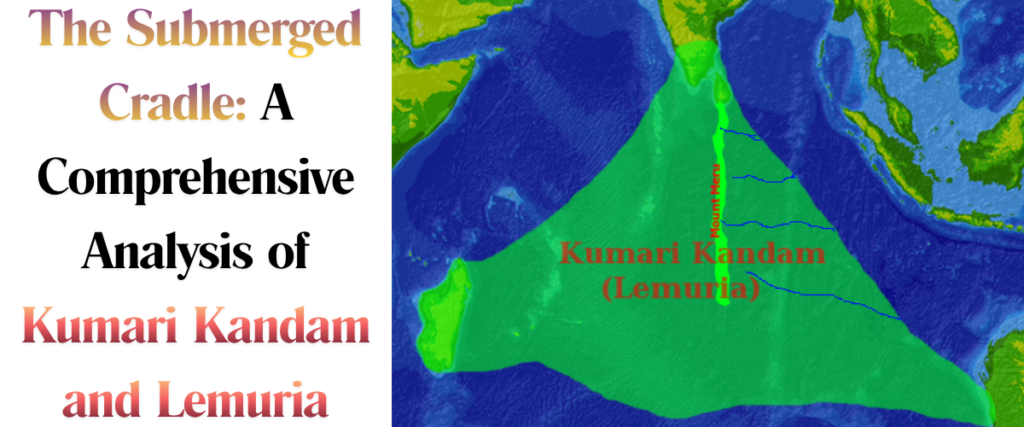
The intellectual history of lost continents represents a unique intersection of empirical science, mystical speculation, and nationalist historiography. For over a century, the narratives of Lemuria and Kumari Kandam have functioned as potent symbols of ancestral loss and cultural origin, evolving from a nineteenth-century zoological hypothesis into a cornerstone of Tamil ethnic identity.1 While modern geology, particularly the theory of plate tectonics, has rendered the physical existence of a sunken continent in the Indian Ocean impossible within the timeframe of human civilisation, the persistence of these stories reflects deeper sociological impulses through which societies construct meaning in the face of colonial and cultural marginalisation.3
The Biogeographical Genesis of a Lost Continent
The concept of Lemuria was not born of myth, but of a rigorous attempt to solve a biological anomaly that perplexed nineteenth-century naturalists. Before the scientific community understood the mechanics of continental drift, researchers struggled to explain the presence of related species on landmasses separated by vast oceans.6 In the mid-1800s, the scientific world was grappling with the implications of Darwinian evolution, which necessitated a clear understanding of how species dispersed from their points of origin.1
Philip Sclater and the Protoprimate Puzzle
In 1864, the British zoologist and biogeographer Philip Sclater published a seminal paper titled The Mammals of Madagascar in The Quarterly Journal of Science.1 Sclater was confronted with a puzzling distribution of lemurs—primates whose fossils and living specimens were found in abundance in Madagascar and the Indian subcontinent, yet were notably absent from the intervening landmasses of Africa and the Middle East.1
The scientific context of the time relied heavily on the postulation of “land bridges” to explain such discontinuities. Sclater hypothesised that a massive continent had once occupied the space of the Atlantic and Indian Oceans, serving as a biological corridor for these primates.1 He proposed the name Lemuria for this hypothetical landmass, drawing from the very creatures that inspired the theory.1 This hypothesis was not considered fringe at the time; it was a serious attempt to align zoology with geology before the mechanism of plate tectonics was discovered.1
| Key Feature | Description of Sclater’s Original Hypothesis |
| Primary Evidence | Fossil remains and living populations of lemurs and lorises 1 |
| Proposed Location | Indian Ocean, connecting Madagascar, Southern India, and Ceylon 1 |
| Geological Mechanism | Gradual breakup and submergence of a massive landmass 8 |
| Scientific Status | Widely accepted in the mid-19th century; later discredited 1 |
The loris and lemur confusion remains a central point of retrospective analysis. In the 1860s, the definition of “lemur” included the slender loris, which is found in India and Sri Lanka.9 Modern genetics and evolutionary biology have since established that while they share common ancestry, lemurs and lorises diverged approximately 70 million years ago.9 The similarities that Sclater observed were the result of older connections through the supercontinent Gondwana, rather than a recent sunken bridge.9
Ernst Haeckel and the Human Missing Link
In 1870, the prominent German biologist Ernst Haeckel, an early proponent of Darwinism, integrated Lemuria into his theories of human evolution.1 Haeckel proposed that Lemuria was the probable primeval home of humanity, serving as the location where the missing link between apes and humans might be found.8 By situating the cradle of humanity in a sunken land, Haeckel provided an elegant, if unverifiable, explanation for why the fossil record of early humans appeared incomplete on known continents.7
Haeckel’s maps often featured a place labelled “Paradise” situated within the submerged boundaries of Lemuria.9 This branding of a scientific hypothesis with biblical terminology facilitated its transition from the laboratory to the wider public imagination, where it began to take on a life of its own as a lost eden.8
The Occult and Esoteric Transformation
The transition of Lemuria from a scientific hypothesis to an esoteric reality was catalysed by the influential figures of the late nineteenth-century occult movement. This shift moved the discourse from the migration of primates to the origins of human consciousness and the spiritual evolution of the soul.1
Helena Blavatsky and the Secret Doctrine
The most profound transformation occurred within the Theosophical Society, co-founded by Helena Blavatsky. In her 1888 work The Secret Doctrine, Blavatsky incorporated Lemuria into a complex mystical-religious doctrine.1 She asserted that the Lemurians were the Third Root Race of humanity, describing them as 15-foot-tall, four-armed, hermaphroditic beings who coexisted with dinosaurs and reproduced via eggs.8
In the Theosophical narrative, Lemuria was not merely a land bridge but a spiritual stage in the evolution of the human soul. Blavatsky claimed that Australia was a surviving remnant of this ancient continent and that Aboriginal populations were of Lemurian and Lemuro-Atlantean origin.1 This esoteric layer added a dimension of astral clairvoyance to the myth, where information was supposedly retrieved through psychic perception rather than empirical digging.3
William Scott-Elliot and the Pacific Migration
The myth continued to expand under William Scott-Elliot, who in The Lost Lemuria (1904) shifted the focus from the Indian Ocean toward the Pacific.9 Scott-Elliot provided vivid details of Lemurian physiology and society, describing beings with bird-like sideways vision and the ability to walk backward and forward with equal facility.9 This Pacific-centric view would later influence the concept of Mu, popularised by James Churchward, who proposed that a massive continent once extended from Hawaii to Easter Island.8
| Occultist Figure | Primary Contribution to the Legend | Characterisation of Lemurians |
| Helena Blavatsky | Integrated Lemuria into Theosophy 1 | Giant, 15-foot-tall egg-laying hermaphrodites 8 |
| William Scott-Elliot | Mapped the continent across the Pacific 9 | Beings with bird-like vision and reversible locomotion 9 |
| James Churchward | Developed the concept of Mu 8 | Inhabitants of the common origin of all great civilisations 15 |
| W. Scott-Elliot | Described the Lemurian Golden Age 14 | Spiritually and psychologically advanced ancestors 14 |
Kumari Kandam: The Tamil Literary Foundation
While Lemuria was a Western invention of the nineteenth century, the concept of a lost land in the south has much older roots in the Tamil-speaking regions of South India. This tradition is known as Kumari Kandam or Kumari Nadu, the Maiden Continent.11
The Puranic and Medieval Roots
The specific term Kumari Kandam first appeared in the Kanda Puranam, a 15th-century Tamil version of the Skanda Purana written by Kachiappa Sivacharyara.11 Although the name has Sanskrit roots—derived from Kumarika Khanda—it was embraced by Tamil revivalists as a purely indigenous designation.11 In the Kanda Puranam, the region is described as a land where Shiva was worshipped, the Vedas were recited, and the Brahmins resided—a description that notably contrasts with later 20th-century secular and anti-Brahmin interpretations of the myth.11
The earliest explicit discussion of a katalkol, meaning “seizure by the ocean,” of Pandyan land is found in a commentary on Iraiyanar Akapporul.11 This commentary, attributed to Nakkeerar and dated to the later centuries of the first millennium CE, mentions that the Pandyan kings established three literary academies known as sangams.2
The Three Sangams of the Pandyan Kings
The narrative of these academies provided a framework for understanding the loss of ancient literature, suggesting that the most profound works of Tamil antiquity perished beneath the waves.16
| Academy Name | Location | Duration (Legendary) | Fate |
| First Sangam (Mudhal Sangam) | Thenmadurai (Southern Madurai) | 4,440 years 16 | Swallowed by the sea 16 |
| Second Sangam (Idai Sangam) | Kapadapuram | 3,700 years 16 | Submerged by a second flood 16 |
| Third Sangam (Kadai Sangam) | Modern Madurai | 1,850 years 16 | Survives as the source of extant literature 16 |
The legendary rulers of Kumari Kandam were depicted as patrons of arts and learning, fostering a vibrant civilisation that flourished with unparalleled wisdom and linguistic prowess.16 The first two academies were presided over by deities and sages, emphasising the divine nature of the ancient Tamil culture.16
The Geography of the 49 Territories
Medieval commentators provided specific geographical details of the lost land, describing it as a vast territory divided into 49 principalities or natu.11 These were classified into seven distinct categories, reflecting a complex societal and geographical organisation.11
| Territory Category | Tamil Name | Descriptive Insight |
| Seven Coconut Lands | elu teñku natu | Tropical regions are defined by coastal abundance 11 |
| Seven Mango Lands | elu maturai natu | Fertile agricultural centres 11 |
| Seven Front Sandy Lands | elu munpalai natu | Coastal arid expanses 11 |
| Seven Back Sandy Lands | elu pinpalai natu | Inland arid expanses 11 |
| Seven Hilly Lands | elu kunra natu | High-altitude territories 11 |
| Seven Coastal Lands | elu kunakarai natu | Maritime and port-centric hubs 11 |
| Seven Forest Lands | elu kurumpanai natu | Densely wooded inland regions 11 |
These lands were irrigated by four great rivers: the Kumari Aaru, Peru Aaru, Pahruli Aaru, and Kanni Aaru.11 The Pahruli River was supposedly excavated by the Pandyan King Nediyon to irrigate a mountain valley.11 The land was also home to a massive mountain range, Meru Malai, featuring 48 high peaks where ruby and gold were mined.11 Legends even speak of “gold mining ants”—Chinese labourers employed by the kings who appeared like ants when viewed from above the deep mine shafts.11
The Fusion: Lemuria Meets Kumari Kandam
In the late 19th and early 20th centuries, these two distinct lineages of thought fused into a single narrative. This synthesis was a deliberate act of cultural appropriation by Tamil scholars seeking to provide scientific legitimacy to their ancient legends.3
The Adoption of Kumarinadu
The name Lemuria first entered the Tamil intellectual world around 1903.19 Scholars such as V.G. Suryanarayana Sastri began using the term Kumarinadu in their works, explicitly identifying the Lemuria of Western scientists with the lost land mentioned in Tamil classics.4 This identification allowed Tamil nationalists to claim that Western science had “proven” the existence of their ancestral homeland.13
T.V. Kalyanasundaram, a famous nationalist and scholar, wrote emphatically that the Lemuria of Westerners was none other than the Kumarinadu of Tamil literature.19 The name Kumari itself suggested a pristine chastity and everlasting youth, embodying the idealisation of the Tamil motherland.19
Resistance and Identity in the Dravidian Movement
The adoption of Lemuria was particularly significant for the emerging Dravidian movement. In the context of British colonial rule and the perceived dominance of Sanskrit narratives, the sunken continent became a symbol of a “pure” Tamil civilisation that predated all others.3 Proponents argued that Kumari Kandam was a utopian society free from the corruption of the caste system and Brahminical influence, which they characterised as later imports from the north.17
By situating the origins of Tamil culture in a submerged, isolated continent, they could explain the lack of archaeological evidence while asserting that Tamil was the world’s oldest language and the cradle of human civilisation.17 R. Mathivanan, a later editor of the Tamil Etymological Dictionary, claimed the civilisation flourished around 50,000 BCE and submerged around 16,000 BCE, providing a temporal depth that challenged all other world histories.17
Geological Critique and Scientific Reality
While the cultural impact of Kumari Kandam remains significant, the scientific community has largely abandoned the notion of a sunken continent in the Indian Ocean as described in these myths. The advancement of Earth sciences in the mid-20th century provided a much more robust framework for understanding the history of the Indian Ocean basin.1
The Demise of the Land Bridge Theory
The primary factor in the scientific rejection of Lemuria was the development of plate tectonics.1 We now understand that the Earth’s crust consists of lighter “sial” rocks that float on heavier “sima” rocks.15 Because continents are huge solid blocks tens of kilometres thick floating on the mantle, they do not simply sink beneath the waves like a ship.15
Instead, the similarities between India and Madagascar are explained by the fact that they were once part of the same supercontinent, Gondwana.8 Approximately 160 million years ago, Gondwana began to break apart, but India and Madagascar remained attached for several million more years before eventually separating.4 This process occurred over tens of millions of years, far predating the appearance of Homo sapiens.3
Meltwater Pulses and Sea-Level Rise
While a vast continent could not have sunk during the time of the Pandyas, smaller-scale coastal inundations are a historical and geological reality. At the end of the last glacial maximum, approximately 14,500 to 7,000 years ago, global sea levels rose significantly as ice sheets melted.4
| Timeframe (Years Ago) | Relative Sea Level (meters below present) | Geological/Cultural Context |
| 14,500 | -100m | Potential land link between India and Sri Lanka 10 |
| 10,000 | -60m | Melting of ice caps leads to rapid flooding 10 |
| 14,600 – 7,600 | Variable | Meltwater pulses causing sudden local inundations 4 |
| 7,000 – 3,000 | Near present | Establishment of historical port cities like Poompuhar 22 |
These meltwater pulses caused sea levels to rise by several meters within a few centuries.4 During these periods, coastal regions would have been submerged, and entire settlements could have been lost.4 It is highly probable that these actual events were preserved in the collective memory of the Tamil people, eventually evolving into the legend of a lost continent.2
The Mauritia Microcontinent: A Scientific Remnant
In a fascinating twist of modern research, scientists have discovered evidence that a lost continent did indeed exist in the Indian Ocean, though its details differ from the myths.12
The Discovery of Mauritia
In 2013 and 2017, researchers identified a Precambrian microcontinent they named Mauritia.12 This landmass was once part of Madagascar and India when they were joined in Gondwana. As the two larger landmasses drifted apart about 85 million years ago, Mauritia underwent a complex splintering, leaving fragments of continental crust adrift in the Indian Ocean.12
Evidence for Mauritia includes gravitational fields that indicate thicker crust in certain parts of the ocean floor and the discovery of three-billion-year-old zircon crystals on the relatively young island of Mauritius.12 While the discovery of Mauritia provides a scientific basis for the existence of submerged continental crust, the timeline is entirely incompatible with the human history of Kumari Kandam, as it sank long before humans existed.4
Archaeological Investigations: Poompuhar and Beyond
The quest for physical evidence has led to significant underwater archaeological efforts along the southeastern coast of India, focusing on submerged structures that might validate the accounts of ancient cities.16
The Poompuhar Discoveries
Poompuhar, or Kaveripoompattinam, was a major port city of the Chola dynasty.22 Local tradition and literature maintain that much of the city was swallowed by a catastrophic sea-level rise or tsunami.16 In the late 1980s and early 1990s, the National Institute of Oceanography (NIO) revealed man-made structures off the coast, including a horse-shoe-shaped object at a depth of 23 meters.22
In 2001, marine archaeologist Graham Hancock and researchers from the NIO videographed submerged ruins that Hancock claimed could date back to 11,000 years ago, potentially predating Sumerian civilisation.22 Hancock cited ancient Tamil flood myths to argue that these ruins represent the remains of the lost kingdom of Kumari Kandam.22
ASI and Recent Marine Excavations
Following the launch of recent underwater archaeological explorations, the Archaeological Survey of India (ASI) has recognised the importance of studying these submerged port cities.23 While the ASI maintains that Poompuhar was a Sangam-era city destroyed by the sea and should not be confused with the hypothetical continent of Kumari Kandam, they acknowledge that oceanographic studies show evidence of significant coastal changes hit by several tsunamis.23
Comparative Mythology and the Global Flood Motif
The legend of Kumari Kandam is not an isolated phenomenon but belongs to a universal category of lost land myths that appear across diverse cultures.18 These stories often share common themes of a lost golden age, advanced culture, and catastrophic destruction.18
Parallels with Atlantis and Mu
The most famous parallel is Plato’s Atlantis, described as an advanced island kingdom that sank into the ocean in a single day and night of misfortune.25 Like Kumari Kandam, Atlantis is often interpreted as a moral allegory of a society that fell into decay and was punished by the gods.25 James Churchward’s Mu mirrors Kumari Kandam in its description as the common origin of all great civilisations. 8
| Mythical Civilization | Ocean/Location | Primary Catastrophe | Key Cultural Motif |
| Atlantis | Atlantic Ocean | Earthquakes and floods 25 | Moral decay and divine punishment 26 |
| Kumari Kandam | Indian Ocean | Kadalkol (seizure by sea) 11 | Cradle of the oldest language 17 |
| Mu | Pacific Ocean | Volcanic gas explosion 15 | Source of all world architecture 15 |
| Neserser | Eastern Sea | Primordial flood 20 | Dwelling of the god Osiris 20 |
These parallels suggest that the story of Kumari Kandam may be the Tamil expression of a widespread psychological response to environmental trauma and the mysteries of deep time.2
The Modern Impact: Identity and Education
The legacy of Kumari Kandam continues to shape Tamil society and politics in the 21st century. It has transitioned from a literal geographical claim to a powerful symbol of cultural resilience and linguistic pride.2
Political and Educational Significance
Throughout the 20th century, Kumari Kandam was a staple of Tamil nationalist discourse. R. Nedunceliyan, a former education minister of Tamil Nadu, published pamphlets insisting that Brahmin historians had deliberately hidden knowledge of Tamil greatness.17 For decades, the myth was included in state textbooks as a historical fact to instil a sense of antiquity.13
In more recent years, there has been a shift. Many state board textbooks now categorise Kumari Kandam under literature rather than history, acknowledging its status as a foundational narrative of identity rather than a geologically verified continent.28 Nevertheless, it remains a potent tool in political debates concerning the indigenous status of Dravidian people.17
Cultural Representations
The myth continues to inspire creative works in Tamil cinema, literature, and digital media.2 Films often depict the Sangams in a visually spectacular setting, reinforcing the collective imagination of a Golden Age.2 For many, Kumari Kandam is not merely a myth but a symbol of their ancient heritage and resilience in the face of natural calamities.16
Conclusion: The Enduring Power of the Sunken Homeland
Kumari Kandam and Lemuria represent more than just a scientific curiosity. They are fabled geographies that allow a community to map its identity onto the past.3 While the literal existence of a massive continent during the human era is unsupported by geological evidence, the legend is rooted in the historical experience of coastal change and the profound literary tradition of the Tamil people.2
The discovery of microcontinents like Mauritia and the underwater ruins of Poompuhar suggest that there are kernels of truth within mythological narratives.12 However, the true power of Kumari Kandam lies in its ability to serve as a metaphor for the antiquity and achievement of Tamil civilisation.2 As long as humans seek to understand their origins, the image of a lost paradise beneath the waves will continue to captivate the imagination.3
Disclaimer
This article is based on a synthesis of historical literature, archaeological claims, and geological theories. The existence of Kumari Kandam and Lemuria as described in nationalist or occultist literature is not supported by the consensus of the international scientific community, particularly in the fields of plate tectonics and human paleontology. The information regarding underwater archaeology is subject to ongoing investigation and interpretation. This document is intended for educational and research purposes and does not assert the historical factuality of mythological or pseudoscientific claims.
Reference
- Lemuria – Wikipedia, accessed on March 27, 2026, https://en.wikipedia.org/wiki/Lemuria
- Lost land and the myth of Kumari Kandam – International Journal of Humanities and Social Science Research, accessed on March 27, 2026, https://www.socialsciencejournal.in/assets/archives/2026/vol12issue1/12058.pdf
- View of Sumathi Ramaswamy, The Lost Land of Lemuria: Fabulous Geographies, Catastrophic Histories., accessed on March 27, 2026, https://journals.gmu.edu/whc/article/view/5008/2947
- Is Lemuria- the lost continent of Tamils ( Kumarikandam in Tamil) a fact or myth ? | ResearchGate, accessed on March 27, 2026, https://www.researchgate.net/post/Is-Lemuria-the-lost-continent-of-Tamils-Kumarikandam-in-Tamil-a-fact-or-myth
- The lost land of Lemuria: Fabulous geographies, catastrophic histories – ResearchGate, accessed on March 27, 2026, https://www.researchgate.net/publication/287415585_The_lost_land_of_Lemuria_Fabulous_geographies_catastrophic_histories
- THE LOST CONTINENT OF LEMURIA – Carnaval de Rua, accessed on March 27, 2026, https://carnavalderua.prefeitura.sp.gov.br/Resources/pOcIgO/8FE148/TheLostContinentOfLemuria.pdf
- Short Stuff: The Lost (?) Continent of Lemuria – Podcasts – Shortform, accessed on March 27, 2026, https://www.shortform.com/podcast/episode/stuff-you-should-know-2025-08-20-episode-summary-short-stuff-the-lost-continent-of-lemuria
- Lemuria: The History and Occult Theories of a Lost World – The Portalist, accessed on March 27, 2026, https://theportalist.com/lost-world-of-lemuria
- Lemuria, the weirdest continent that never existed – Big Think, accessed on March 27, 2026, https://bigthink.com/strange-maps/lost-continent-lemuria/
- I WANT TO KNOW #1 – Legend of Kumari Kandam and its connection to the lost Lemurian continent – Steemit, accessed on March 27, 2026, https://steemit.com/history/@vaseto/i-want-to-know-1-legend-of-kumari-kandam-and-its-connection-to-the-lost-lemurian-continent
- Kumari Kandam | Sundaland Research Program, accessed on March 27, 2026, https://atlantisjavasea.com/2016/04/09/kumari-kandam/
- Have Scientists Discovered Proof for the Lost Continent of Lemuria …, accessed on March 27, 2026, https://www.ancient-origins.net/news-science-space/have-scientists-discovered-proof-lost-continent-lemuria-007478
- The Frenzy About the Weirdest Continent That Never Existed – Atlas Obscura, accessed on March 27, 2026, https://www.atlasobscura.com/articles/lost-continent-lemuria
- ORIGINAL RESEARCH PAPER Dr Neena Bansal – Worldwidejournals.com, accessed on March 27, 2026, https://www.worldwidejournals.com/paripex/recent_issues_pdf/2025/May/the-lost-lands-historiography-of-lemuria-and-kumari-kandam_May_2025_7488971141_4202084.pdf
- Mu (mythical lost continent) – Wikipedia, accessed on March 27, 2026, https://en.wikipedia.org/wiki/Mu_(mythical_lost_continent)
- The Enigma of Kumari Kandam: The Lost Continent – 5 Senses Tours, accessed on March 27, 2026, https://5sensestours.com/the-enigma-of-kumari-kandam/
- Kumari Kandam – Wikipedia, accessed on March 27, 2026, https://en.wikipedia.org/wiki/Kumari_Kandam
- Kumari Kandam: Bharat’s Atlantis and the dawn of Tamil civilisation – Organiser, accessed on March 27, 2026, https://organiser.org/2024/11/24/266263/bharat/kumari-kandam-bharats-atlantis-and-the-dawn-of-tamil-civilisation/
- Tamil Civilisation and the Lost Land of Lemuria/Kumari Kandam – The Peninsula Foundation, accessed on March 27, 2026, https://thepeninsula.org.in/blog/tamil-civilisation-and-the-lost-land-of-lemuria-kumari-kandam
- Kumari Kandam | Sundaland Research Program, accessed on March 27, 2026, https://atlantisjavasea.com/tag/kumari-kandam/
- Histories of a Lost Indian Ocean World – H-Net Reviews, accessed on March 27, 2026, https://www.h-net.org/reviews/showrev.php?id=10707
- “Poompuhar” Underwater Exploration – Ponniyin Selvan Varalaatru Peravai, accessed on March 27, 2026, https://ponniyinselvan.in/forum/discussion/48075/poompuhar-underwater-exploration/p1
- ASI Director Welcomes Tamil Nadu’s Underwater Survey At Poompuhar, Calls It A ‘Great Beginning’ – ETV Bharat, accessed on March 27, 2026, https://www.etvbharat.com/en/!state/asi-director-welcomes-tamil-nadu-underwater-survey-at-poompuhar-calls-it-a-great-beginning-enn25092200923
- Poompuhar with new identity : Birth place of civilisation – Hindu Vivek Kendra, accessed on March 27, 2026, http://www.hvk.org/2002/1202/137.html
- Atlantis (lost civilization) | Social Sciences and Humanities | Research Starters – EBSCO, accessed on March 27, 2026, https://www.ebsco.com/research-starters/social-sciences-and-humanities/atlantis-lost-civilization
- Did these real-life events inspire the myth of Atlantis? – National Geographic, accessed on March 27, 2026, https://www.nationalgeographic.com/history/article/atlantis
- Kumari Kandam The Lost Tamil Continent Beneath the Waves – The Sun, accessed on March 27, 2026, https://www.thesun.lk/front_page/Kumari-Kandam-The-Lost-Tamil-Continent-Beneath-the-Waves/557-302847
- When I was studying in state board we had a topic about Kumari Kandam in our Tamil textbooks, at least TN board had some conscience to put that under langauge and not history. Now state board got rid of that whereas NCERT is teaching fiction under history ( that Aryan migration is false ) : r/TamilNadu – Reddit, accessed on March 27, 2026, https://www.reddit.com/r/TamilNadu/comments/1j72vcx/when_i_was_studying_in_state_board_we_had_a_topic/
- The Dravidian Lemuria Fantasy as History and the Invention of Kumarikandam as Geography – The Dharma Dispatch, accessed on March 27, 2026, https://www.dharmadispatch.in/history/the-dravidian-fantasy-as-history-and-the-mythical-kumarikandam-as-geography