
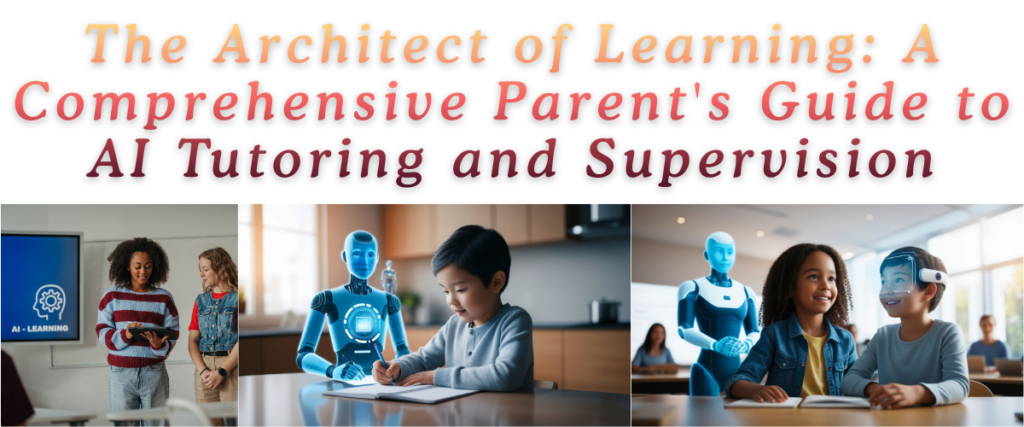
The educational landscape in 2026 is undergoing a paradigm shift that is fundamentally redefining the relationship between students, knowledge, and technology. As generative artificial intelligence transitions from a novelty to an essential pedagogical tool, parents find themselves at the forefront of a digital revolution. The emergence of AI tutors—sophisticated, natural-language platforms capable of delivering personalised instruction—promises to democratise elite education by providing every child with a 24/7 private tutor.1 However, this technological leap brings with it a complex set of responsibilities for parents, who must now serve as the primary supervisors and ethical guides for their children’s AI-driven learning journeys.2
The contemporary AI tutoring market is no longer limited to basic question-and-answer bots. Instead, it encompasses a diverse ecosystem of “Teaching AI” that prioritises the Socratic method of discovery, “Answer AI” designed for immediate homework assistance, and immersive “Creative AI” that transforms passive consumption into active project-based learning.4 Navigating this ecosystem requires a nuanced understanding of cognitive development, data privacy regulations like COPPA and the Australian Online Safety Act, and the psychological implications of forming emotional bonds with synthetic entities.6 This article provides an exhaustive analysis of the AI tutoring landscape, offering data-driven insights and practical strategies for parents to ensure that these tools enhance, rather than diminish, their children’s intellectual and social development.
The Cognitive Architecture of AI Tutoring: Mechanisms of Mastery
At the heart of the AI tutoring revolution is a shift from traditional Intelligent Tutoring Systems (ITS) to generative Large Language Models (LLMs). Traditional systems operated on a “branching” logic, where a student’s incorrect response triggered a pre-scripted hint. Modern AI tutors, such as Khanmigo or Synthesis Tutor, utilise generative capabilities to analyse the specific nature of a child’s confusion and synthesise a unique, contextually relevant explanation.1 This capability addresses the “median challenge” in classrooms, where high-achieving learners are often under-challenged and struggling students fall behind the curriculum pace.1
Research indicates that the most effective AI tutors employ a “mastery-based learning” approach, which focuses on the “productive struggle”—the cognitive effort required to move from confusion to clarity.9 Platforms like Khan Academy leverage AI to ensure that students do not simply memorise answers but achieve a deep conceptual understanding before progressing to more complex topics.9 The patient’s non-judgmental nature of AI is a critical psychological component of this process. Unlike human instructors who may inadvertently signal frustration, AI provides a safe space for students to express confusion and ask clarifying questions repeatedly.1
| Feature | Traditional Software | Generative AI Tutors | Pedagogical Impact |
| Response Type | Pre-scripted / Static | Dynamic / Natural Language | High engagement and personalised clarity 1 |
| Questioning | Fixed Sequences | Socratic / Probing | Develops independent thinking 4 |
| Feedback | Correct/Incorrect | Qualitative / Adaptive | Identifies root causes of errors 11 |
| Pacing | Curriculum-driven | Student-driven | Ensures mastery before progression 9 |
Evidence from rigorous randomised controlled trials (RCTs) conducted in 2025 and 2026 demonstrates the transformative power of these systems. At Harvard University, students using a pedagogically fine-tuned AI tutor achieved more than double the learning gains of those in traditional active-learning classrooms while spending significantly less time on task.1 These gains were not limited to high-resource environments; a World Bank study in Nigeria found that students using Microsoft Copilot for English language learning achieved gains equivalent to nearly two years of “business-as-usual” schooling.1
Understanding the Productive Struggle and Knowledge Transfer
The success of an AI tutor depends on its ability to facilitate knowledge transfer—the application of learned concepts to novel problems. In a study conducted in the United Kingdom, students supervised by a fine-tuned AI model (LearnLM) were 5.5 percentage points more likely to solve new problems in subsequent topics than those receiving only human tutoring.1 This suggests that AI, when prompted to use Socratic dialogue, can effectively mimic the guidance of an expert human tutor, fostering inquisitive, student-led interactions that promote long-term retention.1
For parents, the implication is clear: the goal of AI supervision is not to accelerate the completion of homework, but to ensure the child remains in the “zone of proximal development”—the sweet spot where the material is challenging enough to require effort but not so difficult that it leads to frustration.5 This requires a move away from “Answer AI” tools like Photomath, which provide instant solutions via camera scanning, toward “Teaching AI” platforms that demand active participation.4
Evaluating the Ecosystem: Top AI Tutoring Platforms for 2026
Selecting the right tool for a child involves balancing age-appropriateness, subject matter expertise, and pedagogical rigour. The 2026 market is characterised by several flagship platforms that have set the gold standard for educational AI.
Khanmigo by Khan Academy: The Socratic Coach
Khanmigo remains the most widely recognised AI tutor, largely due to its integration with the extensive Khan Academy curriculum. Unlike general-purpose chatbots, Khanmigo is ethically designed with safety and learning as top priorities.12 It is specifically programmed to avoid giving direct answers, instead acting as a “writing coach” or “math assistant” that asks probing questions to lead the student to their own conclusions.12
For parents, Khanmigo offers one of the most comprehensive monitoring suites in the industry. The parent dashboard includes 20 specific tools, such as the ability to view child chat history, receive moderation alerts for flagged safety concerns, and use a “Summarise Child Chat” feature to quickly understand a child’s progress without reading every line of dialogue.14
Synthesis Tutor: The Multisensory Math Adventure
Synthesis Tutor, developed by the team behind the experimental school at SpaceX, focuses on K-5 mathematics.4 It is particularly effective for neurodiverse learners—including those with Dyslexia, ASD, or ADHD—due to its warm, multisensory, and hands-on approach.4 The platform utilises a digitally-native “adventure” format where math concepts are presented as interactive games.16
A distinctive technical feature of Synthesis is its “Fractional Implicit Repetition” (FIRe) algorithm. Traditional study tools often treat topics as independent units, requiring students to review them individually. Math, however, is hierarchical. Synthesis tracks these relationships; if a student is successfully solving algebraic equations, the system recognises that they have mastered the underlying arithmetic and reduces redundant review.9 This allows students to master foundations 30-50% faster than traditional methods.9
Specialised Tools for Language and Literacy
Early childhood literacy has seen significant innovation through platforms like Ello and Google’s Read Along. Ello is designed for ages 4-8 and acts as a virtual reading coach by “listening” to children read physical books aloud, providing real-time corrections and building reading confidence.13 Similarly, Google Read Along uses AI voice feedback to correct pronunciation errors instantly, supporting a huge library of levelled readers.18
| Platform | Best For | Age Range | Key Feature |
| Khanmigo | K-12 Academics | 5-18+ | Socratic dialogue / Parent Dashboard 12 |
| Synthesis Tutor | K-5 Mathematics | 5-11 | Multisensory learning / FIRe algorithm 9 |
| LittleLit AI | AI Literacy & Subjects | 6-14 | 80-module curriculum / Creative Arcade 19 |
| Ello | Early Literacy | 4-8 | Voice-recognition reading coach 13 |
| Duolingo Max | Languages | All Ages | AI Roleplay & Explain My Answer 4 |
| Wolfram Alpha | STEM | 12+ | Computational engine / Step-by-step logic 4 |
4
The Parent as Facilitator: Strategies for Supervision and “Co-Use”
The most significant risk in the AI era is the “hands-off” approach to technology. Expert consensus emphasises that for AI to be a valuable tool, it should guide the journey of inquiry rather than provide a shortcut.20 This necessitates the “Co-Use” model, where parents actively participate in their child’s AI interactions, especially during the early stages of adoption.20
The Mechanism of Co-Use and AI Literacy
Parents do not need to be AI experts to supervise learning effectively; rather, they must model critical thinking and curiosity.3 Co-use involves sitting with a child to observe their prompts, asking questions like “Why did the AI give that answer?” or “How can we check if this is true?”.21 This process helps children understand that AI is a computer program that looks for patterns in data and makes guesses, not a sentient, all-knowing authority.21
Teaching AI literacy at home involves five core strategies designed to ground a child’s understanding of the technology:
- Explain the Logic: Describe AI as a “smart helper” that learns from examples, like YouTube recommendations or game behaviours in Minecraft.19
- Bite-Sized Concepts: Break down complex terms like “algorithms” or “machine learning” into stories and visual games appropriate for the child’s age.19
- Prioritise Play: Encourage kids to experiment with creative projects, such as training an AI to recognise their pet or designing an AI-powered virtual character.19
- Show Real-World Impact: Connect AI use to tasks children care about, such as composing music or designing stickers for their school binders.19
- Focus on Responsibility: Integrate discussions about fairness, privacy, and the importance of human oversight directly into the learning process.19
The “Abraham Lincoln” Test and Fact-Checking
One of the most effective ways to teach children about AI “hallucinations”—the tendency for models to generate confident but false information—is through “trick questions”.20 Asking an AI to “Describe the time Abraham Lincoln used a telephone” or “Why the US government decided to ban water in 2024” can expose the limits of the technology’s reasoning.21 This builds a “healthy scepticism” in children, encouraging them to view AI output as a draft that requires verification from trusted sources like encyclopedias or official websites.21
Risk Mitigation: Managing Dependency and Psychosocial Impact
The convenience of AI creates a gravitational pull toward over-reliance. Parents must be vigilant against “habit formation,” where a child becomes so accustomed to asking an AI for answers that they lose the ability to think through problems independently.2 This dependency can extend beyond academics into the social realm, where children may start using AI companions as emotional crutches.2
Warning Signs of Unhealthy AI Interactions
Parents should monitor their children for specific behavioural shifts that indicate the AI-child relationship has become unbalanced. Excessive use, secretive behaviour, and distress when access is denied are primary indicators.2
| Indicator | Behavioral Manifestation | Potential Impact |
| Displacement | AI use crowds out sleep, friends, or physical play | Social isolation / Physical fatigue 2 |
| Emotional Crutch | Relying on AI for emotional support instead of people | Stunted emotional intelligence 2 |
| Academic Decay | Inability to explain homework in their own words | Loss of foundational learning 21 |
| Social Transfer | Using impolite or demanding language with humans | Reshaped social norms 20 |
2
To mitigate these risks, families are encouraged to create “Family Tech Agreements”.28 For young children, these agreements might include specific “switch-off” warnings and a focus on joint engagement rather than solitary screen time.28 For teenagers, the focus shifts to digital reputation, the legal consequences of sharing offensive material, and managing the risks of grooming or unwanted contact in apps that may have AI-integrated social features.28
Data Privacy and the Regulatory Safeguards for 2026
The collection of student data by AI platforms presents a critical privacy risk. AI tutors often collect vast amounts of “sensitive information”, which for a child can include their school name, home routines, friendships, and feelings shared during chat sessions.2 Parents must understand the legal protections available and the practical steps needed to secure their child’s digital footprint.
COPPA and the “Verifiable Consent” Mandate
In the United States, the Children’s Online Privacy Protection Act (COPPA) is the primary safeguard for children under 13.6 It requires websites and apps to provide a clear privacy policy specifying data collection and retention periods and to obtain prior, explicit consent from a parent.6 Non-compliance can result in civil penalties as high as $53,088 per violation.6
Recent legislative updates, including the proposed COPPA 2.0 and the Kids Online Safety Act (KOSA), aim to broaden these protections to minors under 17 and introduce mandatory “eraser buttons” that allow parents to permanently delete their child’s personal data.30 These laws also target “compulsive usage” by requiring platforms to implement safeguards that limit addictive design features.30
The Australian Online Safety Framework
Australia has emerged as a global leader in online safety regulation. Effective December 10, 2025, the Australian Government banned social media accounts for children under 16, citing reports that two-thirds of children in that age group had viewed hateful or distressing content.7 While educational tools like Google Classroom and AI tutors are often exempt from this ban, they are subject to strict “Age-Restricted Material Codes”.7
From January 2026, the Australian “Child Safe Standards” require schools and educational providers to maintain online spaces that are safe and well-monitored.7 For parents, this means ensuring that any third-party AI tool used at home complies with the Australian Privacy Principles (APPs) and the forthcoming Children’s Online Privacy Code, which will be fully operational by December 2026.34
| Privacy Protection | Practical Action for Parents |
| Data Minimization | Do not share real names, schools, or addresses 6 |
| Account Control | Create a family account rather than child-specific ones 23 |
| Privacy Settings | Set all accounts to the highest privacy default 29 |
| Vetting | Check for COPPA/FERPA compliance in app terms 35 |
6
Case Studies: Real-World AI Learning in the Home
Understanding how other families navigate AI learning can provide valuable blueprints for success. Case studies from 2025 and 2026 highlight both the transformative potential and the necessary guardrails.
Tobey’s Tutor: Personalising Learning for Dyslexia
In 2025, a parent named Arlyn Gajilan developed a custom AI tutor for her son, Tobey, who struggled with dyslexia despite attending specialised schools.16 By feeding Tobey’s neuropsychological evaluations and report cards into an AI model (with strict data privacy protocols), she created a tool that turned paragraphs into games related to his interests—such as dragons and Hamilton lyrics.16 The result was a notable increase in Tobey’s confidence and reading fluency. The AI was programmed with specific “guardrails” to alert parents if the child typed words hinting at frustration or self-harm.16
Julia’s Homeschooling Journey
Julia, a homeschooling mother, integrated AI to manage the diverse needs of her three children: one gifted in math, one struggling with reading, and a curious kindergartener.10 By using a platform like LittleLit, she transitioned from a “content creator” to a “learning facilitator”.10 The AI automatically adjusted lesson difficulty, tracked progress for state-level standards, and allowed the children to work independently while still being guided by a structured pedagogical framework.10 This shift allowed Julia to focus on providing the emotional support and moral guidance that AI cannot replicate.8
Family-Friendly AI Activities: Turning Technology into Togetherness
Beyond traditional tutoring, AI can be integrated into the home in ways that foster creativity and collaborative problem-solving. These activities help children view technology as a tool for “building and exploring” rather than just a source of passive entertainment.23
- AI Storytelling Contests: Use a tool like ChatGPT or AI Dungeon to generate the beginning of a story and have family members take turns “improving” the AI’s plot or correcting its logic.18
- Meal Planning as a Logic Game: Ask an AI to help plan family meals based on conflicting preferences (e.g., “Must be vegetarian, kid-friendly, and use the broccoli in the fridge”). This demonstrates how AI processes complex constraints.23
- Creative Design Challenges: Use Midjourney or Sora to illustrate a school report or visualise a world for a weekend project. Discuss the difference between “AI-assisted creation” and claiming the AI’s work as one’s own.23
- The “Race the Computer” Game: Challenge children to solve a riddle or a logic puzzle faster than the AI can generate a hint.5
- Nighttime Routine Creators: Use AI to generate a personalised bedtime story where the child is the hero, incorporating their specific daily wins as “character levels”.5
The Future Landscape: AI in 2030 and Multimodal Interfaces
The next five years will see AI tutors transition from text-based chatbots to “multimodal” interfaces that interact through voice, video, gestures, and AR/VR environments.38 By 2026, it is projected that 18% of higher education institutions will offer VR-required courses, a trend that is rapidly moving into the K-12 sector.38
Immersive Spatial Learning
The integration of the “metaverse” into education will allow children to explore immersive science labs or historical reconstructions alongside an autonomous teaching assistant.38 These systems will achieve even higher accuracy (projected at 97.2% for factual queries) and provide sophisticated feedback on open-ended assignments like essays or coding projects.38
However, as AI becomes more ubiquitous, the human role in education—both as teachers and parents—becomes more critical. AI is excellent at information processing, but it lacks the “crucial capacity of caring” found in parents and educators.8 The future of learning will be defined by a “human-centred approach,” where AI accelerates the delivery of information, but human relationships remain the primary driver of emotional, social, and moral development.39
Practical Checklist for Parents Evaluating AI Tutors
Before committing to an AI tutoring platform, parents should use the following checklist based on industry standards from Common Sense Media and the EDSAFE AI Alliance.41
- Pedagogical Rigour: Does the tool use Socratic questioning, or does it simply give answers? 4
- Data Security: Is the tool COPPA/FERPA compliant? Is there a clear “eraser button” for data? 30
- Parental Oversight: Does the platform provide a dashboard to monitor chat history and moderation alerts? 14
- Bias Mitigation: Does the provider explain how they mitigate algorithmic bias in their training data? 44
- Age Appropriateness: Is the content complexity and tone adjusted for the child’s developmental stage? 13
- Accuracy: Does the tool include accuracy safeguards, such as step-by-step verified answer sets? 1
- Offline Accessibility: Can the tool function with limited connectivity, or does it require constant high-speed internet? 46
Conclusion
The integration of AI tutors into a child’s educational lifecycle represents one of the most significant shifts in parental responsibility in the 21st century. These tools offer a powerful mechanism for closing learning gaps, boosting engagement, and providing personalised support at scale.1 Yet, the benefits of AI are not automatic; they are the result of careful selection, active supervision, and the maintenance of a healthy “productive struggle”.9
Parents must serve as the architects of this new learning environment, balancing the efficiency of technology with the irreplaceability of human connection. By fostering AI literacy, enforcing strict privacy standards, and modelling critical thinking, families can ensure that AI tutors remain “helpers” rather than “replacements”.21 As we move toward a future of immersive, multimodal education, the core principles of curiosity, integrity, and ethical responsibility will remain the most essential skills a child can develop.23
Disclaimer
This research article is provided for general informational and educational purposes only. Artificial intelligence is a rapidly evolving field, and the performance, safety features, and privacy policies of the tools mentioned are subject to change without notice. Mention of specific platforms or services does not constitute an endorsement. Parents and guardians are responsible for reviewing the terms of service and privacy policies of any AI tool before allowing a child to use it. This document does not provide legal, psychological, or professional educational advice. For specific concerns regarding a child’s learning differences or developmental health, please consult with a qualified educator, medical professional, or legal expert. Compliance with regional data protection laws, such as COPPA in the USA or the Privacy Act in Australia, is the responsibility of both the software provider and the user.
References
- What the research shows about generative AI in tutoring | Brookings, accessed on March 10, 2026, https://www.brookings.edu/articles/what-the-research-shows-about-generative-ai-in-tutoring/
- Protecting Children in the Age of AI | UNICEF USA, accessed on March 10, 2026, https://www.unicefusa.org/stories/protecting-children-age-ai
- AI In Education: What Parents and Caregivers Should Know, accessed on March 10, 2026, https://www.aiforeducation.io/ai-resources/ai-in-education-what-parents-and-caregivers-should-know
- Best AI Tutoring Apps for Kids in 2026 – Khanmigo, Socratic & More …, accessed on March 10, 2026, https://spellingjoy.com/best-apps/ai-tutoring-apps
- AI Guidance for Parents and Guardians – Prince George’s County Public Schools, accessed on March 10, 2026, https://www.pgcps.org/offices/information-technology/technology-training-and-instructional-technology/artificial-intelligence/ai-guidance/ai-guidance-for-parents-and-guardians
- COPPA Compliance: Full Overview & Action Point Checklist – Usercentrics, accessed on March 10, 2026, https://usercentrics.com/knowledge-hub/coppa-compliance/
- Beyond the ban: Leading schools through upcoming Online Safety reforms, accessed on March 10, 2026, https://www.cbp.com.au/insights/publications/beyond-the-ban-leading-schools-through-upcoming-online-safety-reforms
- Social media safety, privacy literacy and gentle parenting – IAPP, accessed on March 10, 2026, https://iapp.org/news/a/social-media-safety-privacy-literacy-and-gentle-parenting
- AI Tutoring for Homeschool: An Honest Assessment (2026) – OpenEd, accessed on March 10, 2026, https://opened.co/blog/ai-tutors-homeschool
- What One Homeschool Mom Achieved with an AI Tutor, accessed on March 10, 2026, https://www.littlelit.ai/post/what-one-homeschool-mom-achieved-with-an-ai-tutor-1
- The results are in: AI tutoring works – Flint, accessed on March 10, 2026, https://flintk12.com/blog/the-results-are-in-ai-tutoring-works
- Meet Khanmigo: Khan Academy’s AI-powered teaching assistant & tutor, accessed on March 10, 2026, https://www.khanmigo.ai/
- 2026 Must-Read Guide for Parents and Teachers: The World’s Most Popular AI Education Tools for Children – Picture Cook, accessed on March 10, 2026, https://picture-cook.com/articles/2026-must-read-guide-for-parents-and-teachers-the-world-s-most-popular-ai-education-tools-for-children
- What Khanmigo tools are available to parents? – Khan Academy, accessed on March 10, 2026, https://support.khanacademy.org/hc/en-us/articles/21823169137037-What-Khanmigo-tools-are-available-to-parents
- How to Use Khanmigo Tools for Parents (video) – Khan Academy, accessed on March 10, 2026, https://www.khanacademy.org/khan-for-parents/khan-for-families/x47d2dcef03b6d5f6:how-to-leverage-khanmigo/x47d2dcef03b6d5f6:khanmigo-parent-tools/v/how-to-use-khanmigo-tools-for-parents
- How One Mom Built An AI Tutor for Her Son – Stephen Gaynor School, accessed on March 10, 2026, https://www.stephengaynor.org/how-one-mom-built-an-ai-tutor-for-her-son/
- How personal AI tutors are helping students and reshaping education – Stand Together, accessed on March 10, 2026, https://standtogether.org/stories/education/how-ai-personal-tutors-are-re-shaping-education
- Best AI Tools for Primary Kids: Top Picks for Young Learners – Zoomax USA, accessed on March 10, 2026, https://zoomaxusa.com/low-vision-blog/low-vision-life/best-ai-tools-for-primary-kids/
- 6 Best AI Tools for Kids in 2025 (Better Than ChatGPT) – LittleLit AI, accessed on March 10, 2026, https://www.littlelit.ai/post/forget-chatgpt-these-ai-tools-for-kids-will-blow-your-mind
- Youth and Generative AI: A Guide for Parents and Educators – Children and Screens, accessed on March 10, 2026, https://www.childrenandscreens.org/learn-explore/research/youth-and-generative-ai-a-guide-for-parents-and-educators/
- Tips for Teaching Your Kids How to Use AI – Our Children Magazine, accessed on March 10, 2026, https://ptaourchildren.org/tips-for-teaching-your-kids-how-to-use-ai/
- Parenting in the AI age | UNICEF Parenting, accessed on March 10, 2026, https://www.unicef.org/parenting/digital-parenting/how-approach-ai-children
- Teaching Kids About AI: A Parent’s Guide to Curiosity and Critical …, accessed on March 10, 2026, https://fosi.org/teaching-kids-about-ai-a-parents-guide-to-curiosity-and-critical-thinking/
- Children, AI, and Safety: A Guide for Australian Parents, accessed on March 10, 2026, https://www.notmykid.com.au/blog/children-ai-and-safety-a-guide-for-australian-parents
- Guidance on AI and Children – Unicef, accessed on March 10, 2026, https://www.unicef.org/innocenti/media/11991/file/UNICEF-Innocenti-Guidance-on-AI-and-Children-3-2025.pdf
- Are Our Children Using AI Without Us Noticing? | UNICRI, accessed on March 10, 2026, https://unicri.org/news-AI_Literacy-for-Children-Guide-Video-AI-forGood-Global-Summit-2025
- Children’s perspectives on their best interests and AI – UNICEF.org, accessed on March 10, 2026, https://www.unicef.org/innocenti/stories/childrens-perspectives-their-best-interests-and-ai
- Online safety basics | eSafety Commissioner, accessed on March 10, 2026, https://www.esafety.gov.au/parents/issues-and-advice/online-safety-basics
- Privacy and your child – eSafety Commissioner, accessed on March 10, 2026, https://www.esafety.gov.au/parents/issues-and-advice/privacy-child
- Wave of Federal “Online Safety” Legislation Hits Congress | Davis Wright Tremaine, accessed on March 10, 2026, https://www.dwt.com/insights/2026/01/federal-online-safety-legislation-hits-congress
- From deepfakes to grooming: UN warns of escalating AI threats to children – UN News, accessed on March 10, 2026, https://news.un.org/en/story/2026/01/1166827
- Australia introduces strict online child safety rules covering AI chatbots, accessed on March 10, 2026, https://dig.watch/updates/australia-introduces-strict-online-child-safety-rules-covering-ai-chatbots
- National Child Safety Review – new sector guidance – Department of Education, accessed on March 10, 2026, https://www.education.gov.au/early-childhood/announcements/national-child-safety-review-new-sector-guidance
- Children’s Online Privacy Code – OAIC, accessed on March 10, 2026, https://www.oaic.gov.au/privacy/privacy-registers/privacy-codes/childrens-online-privacy-code
- Generative Artificial Intelligence in Internet Safety Policies, Acceptable Use Policies, and Codes of Conduct Guidance – Delaware Department of Education, accessed on March 10, 2026, https://education.delaware.gov/wp-content/uploads/2025/02/GenAI_ISP-AUP-CodeConduct_Guidance.pdf
- AI Policies and Guidelines for Schools, accessed on March 10, 2026, https://www.theschoolhouse.org/post/ai-policies-guidelines-schools
- The Best AI Tools for Parents, Teachers & Families in 2026 – Momizen, accessed on March 10, 2026, https://momizen.com/en/posts/best-ai-tools-for-families-2026
- The Future of AI in Education: 2026 Trends Report | X-Pilot Research, accessed on March 10, 2026, https://www.x-pilot.ai/blog/future-ai-education-2026-trends-report
- AI and Early Childhood Education: Opportunities, Concerns, and Recommendations – Institute for Child Success, accessed on March 10, 2026, https://www.instituteforchildsuccess.org/wp-content/uploads/2025/09/ICS_AI-and-ECE_Aug-2025.pdf
- Artificial intelligence in education – AI | UNESCO, accessed on March 10, 2026, https://www.unesco.org/en/digital-education/artificial-intelligence
- A Parent’s Guide to AI Advocacy in Education – Ai Policy Lab, accessed on March 10, 2026, https://www.aipolicylab.org/post/a-parent-s-guide-to-ai-advocacy-in-education
- Day of AI and Common Sense Media Launch Essential Toolkit for Parents and Families, accessed on March 10, 2026, https://dayofai.org/news/day-of-ai-and-common-sense-media-launch-essential-toolkit-for-parents-and-families-talking-to-kids-about-ai-privacy-fairness-and-responsibility
- Guide to Monitoring Kids’ AI Interactions – Aura Help Center, accessed on March 10, 2026, https://help.aura.com/s/article/guide-to-monitoring-kids-ai-interactions
- Responsible AI for Measurement and Learning: Principles and Practices – ETS, accessed on March 10, 2026, https://www.ets.org/Media/Research/pdf/RR-25-03.pdf
- Parent Guide to AI in Schools: K–12 Policy & Digital Literacy – Education Briefs, accessed on March 10, 2026, https://www.thethinkacademy.com/blog/edubriefs-parent-guide-to-ai-in-schools-k-12-policy-and-digital-literacy/
- AI in Education in Australia: Benefits, Use Cases & Roadmap (2026) – Appinventiv, accessed on March 10, 2026, https://appinventiv.com/blog/ai-in-education-in-australia/
- AI Tutoring Brings Real-Time Support Remote Students – Education Daily, accessed on March 10, 2026, https://educationdaily.au/automation/ai-tutoring-brings-real-time-support-remote-students/