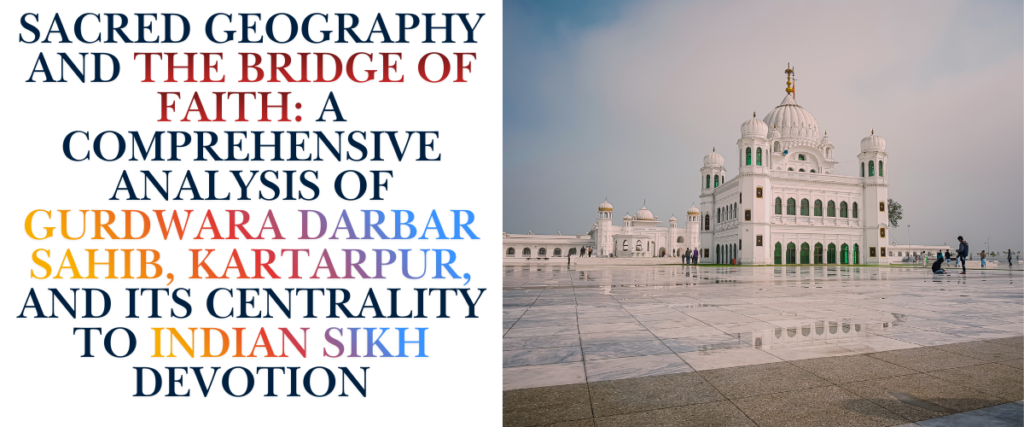
The spiritual landscape of the Sikh faith is defined by a unique relationship between geography, memory, and the divine. For the global Sikh community, and specifically for those residing in India, few sites hold as much transformative power as Gurdwara Darbar Sahib, Kartarpur. Located on the right bank of the Ravi River in Pakistan’s Narowal district, this sacred site represents the foundational cradle of Sikhism.1 It is not merely a destination for religious tourism but is widely regarded as the “City of the Creator,” the place where the abstract spiritual insights of Guru Nanak Dev Ji, the first Sikh Guru, were crystallised into a lived social reality.1 The significance of Kartarpur for Indian Sikhs is multifaceted, encompassing historical reverence, the trauma of the 1947 Partition, the ritual of long-distance devotion, and the complex geopolitical struggle for physical access that culminated in the opening—and subsequent challenges—of the Kartarpur Corridor.
The Settlement of the Soul: Guru Nanak’s Final Years (1521–1539)
To understand why Kartarpur evokes such deep emotion in the heart of an Indian Sikh, one must look back to the early 16th century. After completing his four major missionary journeys, known as Udasis, which took him to the far corners of South Asia, the Middle East, and the Himalayas, Guru Nanak Dev Ji chose to settle in Kartarpur.2 This transition from a life of constant travel to one of settled communal living marked a pivotal era in Sikh history. It was during his eighteen years here, from 1521 until his passing in 1539, that the fundamental pillars of the Sikh way of life were established.1
At Kartarpur, Guru Nanak was not a distant mystic but an active participant in the community. He took up farming, emphasising the principle of Kirat Karo (honest labour), and demonstrated that spiritual enlightenment was entirely compatible with the life of a householder.3 This rejection of asceticism in favour of social engagement is a core tenet of Sikh identity. The Guru’s presence turned Kartarpur into a centre of wisdom where followers gathered to hear his hymns, which were later enshrined as Bani in the Guru Granth Sahib.1
| Feature of Kartarpur Settlement | Theological/Social Significance | Reference |
| Establishment (1504/1521) | Foundation of a new social order based on the “City of God.” | 3 |
| Agricultural Practice | Institutionalisation of Kirat Karni (Honest Labour). | 4 |
| Communal Living | The birth of the first informal Sikh Baradari (Community). | 1 |
| Langar Institution | Radical equality through shared meals regardless of caste. | 1 |
| Hymn Composition | Creation of foundational scriptures like Japji Sahib. | 2 |
The narrative of Guru Nanak’s end at Kartarpur is also a powerful symbol of interfaith harmony. According to legend, upon his death, a dispute arose between his Hindu and Muslim followers over whether to cremate or bury him.2 When the shroud was lifted, his body had vanished, replaced by a heap of flowers. The flowers were divided, with the Hindus cremating their portion and the Muslims burying theirs.2 This dual heritage is still reflected in the architecture of the shrine today, which houses both a Samadhi (Hindu tradition) and a Grave (Muslim tradition), making Kartarpur a unique symbol of universal brotherhood that transcends religious boundaries.1
The Rupture of 1947: A Divided Heritage
The importance of Kartarpur for Indian Sikhs cannot be untangled from the historical trauma of the 1947 Partition. When British India was divided into the sovereign nations of India and Pakistan, the Punjab province was bifurcated based on the Radcliffe Line.6 This boundary was drawn with haste that often ignored the sacred geography of the region. While the majority of the Sikh population migrated to the Indian side of the border, many of their most revered sites, including Nankana Sahib (the Guru’s birthplace) and Kartarpur Sahib (his final resting place), remained in Pakistan.3
The specific location of Kartarpur, just 4.7 kilometres from the newly created border, turned it into a “forbidden fruit” for the Sikh community in India.6 For decades, the Ravi River acted as a physical and political barrier. The Jassar bridge, which once allowed informal travel, was destroyed during the 1965 war, further sealing the border.6 This geographical separation transformed Kartarpur from a local village shrine into an international symbol of loss and longing. The sight of the white dome from across the border became a focal point for the collective grief of a community that had been uprooted from its spiritual home.10
The Architecture of Longing: Binocular Darshan at Dera Baba Nanak
In the years following the 1947 division, a unique ritual emerged at the Indian border town of Dera Baba Nanak in Gurdaspur. Because the Kartarpur shrine was visible from the Indian side on a clear day, the town became a site of “surrogate pilgrimage”.11 The Border Security Force (BSF) constructed a raised platform, or Darshan Sthal, near the international border, allowing Indian Sikhs to catch a glimpse of the gurdwara across the fields and the river.11
This “binocular darshan” became an essential part of the Sikh religious experience in India. For thousands of devotees who lacked the means or the visas to travel to Pakistan, peering through a pair of optics was their only way to perform Darshan (sacred viewing).11 The act of looking across the fence became a powerful theological statement. Every day, pilgrims would gather, fold their hands in prayer, and bow toward the distant white dome.11 This tradition highlighted the concept of Ardas—the daily Sikh prayer—in which millions seek unhindered access to the shrines they were separated from during the Partition.1
As technology advanced, so did the means of this long-distance devotion. In early 2024, the platform at Dera Baba Nanak was facelifted, with the installation of high-range binoculars and LED screens to provide a clearer view of the shrine for those unable to pay the corridor fees or obtain the necessary travel documents.13 This evolution of the viewing point underscores the enduring nature of the Sikh community’s connection to Kartarpur; if they could not walk on its soil, they would at least witness its presence with unwavering focus.10
The Long Road to the Corridor: Decades of Advocacy and Diplomacy
The realisation of the Kartarpur Corridor in 2019 was the culmination of over seven decades of yearning and twenty years of active diplomatic maneuvering. The demand for a visa-free passage was not just a religious request but a political necessity for the Sikh community in Indian Punjab. Discussions regarding a corridor first gained traction in 1998–1999 during the “Bus Diplomacy” between Prime Ministers Atal Bihari Vajpayee and Nawaz Sharif.6 At that time, Pakistan renovated the shrine and made it more visible from the border as a goodwill gesture.6
However, the volatile nature of Indo-Pak relations—marked by the Kargil War, the Parliament attack, and the Mumbai attacks—repeatedly stalled the project. It was not until 2018 that a convergence of political will on both sides allowed the project to move forward.6 The corridor was finally inaugurated on November 9, 2019, by Prime Minister Narendra Modi in India and then-Prime Minister Imran Khan in Pakistan, timed to coincide with the 550th birth anniversary of Guru Nanak.4
The opening of the corridor was hailed as a “Berlin Wall” moment for South Asia.6 For the Indian Sikh community, it was a moment of profound emotional release. Pilgrims who had only ever seen the shrine through binoculars were now able to walk across the border and touch the sacred earth.10 This breakthrough was not just a victory for diplomacy but a testament to the “Sikh Soft Power” and the lobbying efforts of the global diaspora, who had kept the issue on the international agenda for decades.9
Administrative Sovereignty: The Mechanics of Visa-Free Travel
The Kartarpur Corridor operates under a unique administrative framework that balances religious freedom with national security concerns. For an Indian Sikh, the journey is distinct from a typical international trip. While it is “visa-free,” it is by no means unregulated.6
| Category | Requirement/Rule | Practical Implication for Pilgrims |
| Eligibility | Indian Citizens or OCI Cardholders. | Excludes other nationalities; requires a valid Indian identity.21 |
| Registration | Online portal (prakashpurb550.mha.gov.in). | Must register 10-14 days in advance; no offline option.21 |
| Travel Document | Valid Passport (not stamped) + ETA. | The passport serves as ID, but the ETA is the actual permit to cross.21 |
| Service Fee | $20 USD per person. | A point of contention covers infrastructure and langar costs.6 |
| Duration | Dawn to Dusk (Same-day return). | Pilgrims cannot stay overnight or visit other parts of Pakistan.21 |
| Group Travel | Groups of 15 preferred. | Encourages communal safety and organised processing.21 |
The registration process is meticulous. Applicants must upload their passport details and undergo police verification before receiving an Electronic Travel Authorisation (ETA).21 Once at the border, they pass through a state-of-the-art Passenger Terminal Building (PTB) at Dera Baba Nanak, which houses immigration and customs checks.21 This system represents a compromise between the two nations: a “visa-free” status that nonetheless allows for strict monitoring of all movement.10
The Physicality of Faith: Architecture and Expansion of Darbar Sahib
For a pilgrim arriving from India, the first sight of the expanded Gurdwara Darbar Sahib complex is often overwhelming. What was once a modest structure in a quiet field has been transformed into a massive architectural marvel spread over 42 acres.3 This expansion, completed by the Pakistani government in 2019, was designed to accommodate the influx of up to 5,000 pilgrims daily.6
The complex is built using white marble, reflecting the purity and serenity associated with Guru Nanak’s teachings.1 The main prayer hall houses the Guru Granth Sahib and is surrounded by wide courtyards where devotees can sit and reflect.1 The infrastructure includes vast langar halls where free meals are served around the clock, upholding the tradition of selfless service established by the Guru.1
The site also preserves several historical relics that serve as tangible links to the 16th century. Among these is a 500-year-old well made of small red bricks, believed to have been used by Guru Nanak himself to water the fields.4 For the Indian Sikh, these physical markers are not just archaeological sites; they are “relics of the living spirit”.2 Every brick and courtyard is a reminder of the Guru’s message that there is no Hindu and no Muslim, but only humanity.1
The Human Dimension: Emotional Reunions and Shared Memories
The true importance of Kartarpur lies in the human stories that unfold within its walls. For many families in both Indian and Pakistani Punjab, the corridor has served as a site of profound reconciliation. The Partition split families apart for over seventy years, and Kartarpur provided a neutral ground where long-lost relatives could finally meet.10
One such story is that of Nusrat, a woman from Sialkot, Pakistan, who used the corridor to meet her maternal uncle from Jammu, India, after forty years of separation.18 These reunions are often characterised by tears, long embraces, and the sharing of childhood memories. For these families, Kartarpur is not just a religious site; it is a “bridge of hope” that heals the wounds geography refused to forget.10
The corridor also facilitates interactions between young people from both sides. Indian pilgrims and Pakistani students often find themselves sitting together in the langar hall, discovering that despite the decades of political hostility, they share the same language, food, and culture.18 This people-to-people contact is perhaps the most significant “second-order” effect of the corridor, as it humanises the “other” and challenges the narratives of bigotry that have often defined Indo-Pak relations.7
Geopolitical Fragility: The Crisis of 2025 and the Current Standoff
The history of the Kartarpur Corridor is a cycle of hope and heartbreak. While the 2019 inauguration was a high point, the corridor has remained vulnerable to the security dynamics of the region. In May 2025, a terror attack in Pahalgam and subsequent Indian military response known as “Operation Sindoor” led to a sharp escalation in border tensions.10
As a result of these clashes, the Kartarpur Corridor was suspended by Indian authorities, citing security concerns for pilgrims.10 This closure was a devastating blow to the Sikh community, who saw the corridor as an “experiment in faith-based diplomacy” that should be kept separate from military conflict.10 As of March 10, 2026, the corridor remains closed for regular crossings, according to international travel advisories.28
| Period | Status of Corridor | Driving Factors |
| Nov 2019 – Mar 2020 | Open | Initial post-inauguration phase; “Bridge of Hope”.6 |
| Mar 2020 – Nov 2021 | Closed | COVID-19 pandemic restrictions.16 |
| Nov 2021 – May 2025 | Open | Period of steady pilgrimage; renewal of agreement in 2024.16 |
| May 2025 – Present (Mar 2026) | Closed | Suspension following the Operation Sindoor and Pahalgam attack.10 |
The current deadlock highlights the central paradox of Kartarpur: it is a site of eternal spiritual importance that is managed by transient political interests. While India and Pakistan renewed the bilateral agreement for the corridor in October 2024 for another five years (until 2029), this legal renewal has not translated into operational access during periods of high military alert.23 The Sikh community in India is once again left in a state of longing, returning to the binoculars at Dera Baba Nanak to gaze at a shrine that is physically close but politically distant.10
The Global Sikh Diaspora: Identity, Soft Power, and Advocacy
While the corridor is a bilateral issue between India and Pakistan, its significance is monitored closely by the global Sikh diaspora. Millions of Sikhs in the UK, Canada, the United States, and Australia view Kartarpur as a vital anchor of their identity.1 For the diaspora, the preservation of Sikh heritage sites in Pakistan is a matter of international religious rights.
Organisations like the Sri Nankana Sahib Foundation have spent decades lobbying for Khule Darshan Didar (unhindered access).19 The opening of the corridor in 2019 was seen as a victory for this global movement. UN Secretary-General António Guterres, during a visit in 2020, dubbed it a “corridor of hope” and a “symbol of interfaith harmony,” elevating the status of the site on the world stage.9
The diaspora also views the corridor as a tool of “Sikh Soft Power”.9 By showing that faith can bridge the divide between two nuclear-armed neighbours, the Sikh community projects an image of being active facilitators of peace.9 However, the 2025 closure has sparked international criticism, with Sikh leaders in Pakistan and abroad urging India to lift the ban and allow religious practices to proceed regardless of political tensions.27 The diaspora continues to serve as the “moral conscience” of the corridor, reminding both governments that the site belongs to the faithful and not just the states.19
Socio-Economic and Cultural Ripple Effects
The importance of Kartarpur also extends to the local economies and the cultural fabric of the Punjab region. On the Pakistani side, the project has brought significant investment to the Narowal district, creating jobs in construction, hospitality, and tourism.7 The $20 fee, though controversial, has funded a massive infrastructure project that includes roads, bridges, and the maintenance of the shrine.6
On the Indian side, the town of Dera Baba Nanak has seen a transformation from a quiet border outpost to a hub of activity. The construction of the Integrated Check Post (ICP) and the upgrade of viewing platforms have bolstered local pride and tourism.13 Culturally, the corridor has revived the “Sanjha Punjab” (Shared Punjab) sentiment, where the shared heritage of language, music, and food takes precedence over the divisions of 1947.7
The corridor has also influenced Sikh art and literature, with new hymns and poems being composed to celebrate the “opening of the gates”.1 The memory of walking across the bridge and seeing the white dome for the first time has become a new “foundational myth” for the modern Sikh community, a story of hope to be passed down to future generations.10
The Rituals and Symbols of Kartarpur: A Deep Dive
For the Indian Sikh, every aspect of Kartarpur is laden with symbolic meaning. It is not just the building, but the specific rituals performed there that define its importance.
The Sacred Soil and Farming
Because Guru Nanak farmed the land here, the soil of Kartarpur is considered blessed. Pilgrims often touch the ground or even take a small amount of soil with them as a relic.10 This act connects them to the Guru’s teaching that the earth is our “Great Mother” (Mata Dharat Mahat).3 The agricultural heritage of the site is a reminder that spirituality is rooted in the humble work of providing for others.
The Well of Nanak
The 500-year-old well is a central focal point for visitors. Drinking or sprinkling the water from this well is seen as an act of purification and connection to the Guru’s physical life.4 In a region where water has often been a source of conflict, the “Well of Nanak” stands as a symbol of shared life and the “miraculous” nature of divine provision.2
The Dual Memorials
The presence of the Samadhi and the Mazar (grave) in the same courtyard is perhaps the most unique aspect of Kartarpur. For Indian Sikhs, this is a visual representation of the Guru’s message: Sabhna Jiya Ka Ek Data (There is only one giver of all beings). In a world plagued by religious polarisation, Kartarpur offers a different model of coexistence, where the same saint can be honoured by two different faiths under one roof.1
The Path Forward: Challenges and Opportunities for 2026–2029
As of March 2026, the Kartarpur Corridor stands at a crossroads. The legal agreement has been renewed, but the physical gates are closed due to the fallout from the 2025 conflict.10 This situation presents both a challenge and an opportunity for the future of Sikh-state relations in India.
The Demand for Consistency
There is a growing demand within the Sikh community for the corridor to be treated as a “permanent humanitarian passage” that is immune to political cycles.27 Sikh leaders have pointed out the inconsistency of allowing cricket matches or trade through other channels while halting religious pilgrimage.10 For the Indian government, balancing the religious rights of its citizens with national security remains a delicate act of governance.
The Potential for “Religious Corridors”
If the Kartarpur model can be successfully insulated from conflict, it could pave the way for other corridors. There is significant interest in opening a similar route to Sharda Peeth in Pakistan-administered Kashmir for Hindu pilgrims.7 The “Kartarpur Experiment” is therefore a litmus test for the possibility of a “softer border” in South Asia, where the shared spiritual heritage of the people acts as a counterweight to the hard security concerns of the states.7
Conclusion: The Eternal Horizon of Kartarpur
Gurdwara Darbar Sahib, Kartarpur, is far more than a physical location on a map; it is the spiritual compass for the Sikh faith. For Indian Sikhs, it represents the intersection of their most sacred history and their most painful modern trauma. It is the site where the Guru lived, worked, and preached a message of radical equality that still resonates today. The seventy-two years of separation only served to heighten the shrine’s importance, turning it into a symbol of a community’s resilience and its refusal to be permanently divided from its roots.
The opening of the corridor in 2019 was a moment of transcendence, proving that even the most fortified borders can be opened by the power of faith and the demand of the people. While the current suspension in 2026 is a reminder of the fragility of peace in South Asia, it cannot erase the memory of the thousands who have already crossed the bridge. Kartarpur remains a “corridor of hope,” a vision of what a more compassionate and connected South Asia could look like. For every Indian Sikh who stands at the border today, looking through binoculars or waiting for the gates to reopen, Kartarpur is the eternal horizon—a destination that is not just reached by travel, but by an unwavering commitment to the values of truth, labour, and love that were first planted in its soil five centuries ago.
Disclaimer
This report is based on historical research, archival data, and current affairs as of March 2026. The operational status of the Kartarpur Corridor and travel requirements are subject to the sovereign decisions of the governments of India and Pakistan and may change without notice due to security or diplomatic reasons. This document is intended for educational and research purposes and should not be used as an official travel guide. All pilgrims are advised to check current government portals and travel advisories before planning a visit.
Reference
- Kartarpur Sahib: The Sacred Land of Guru Nanak – Dasvandh Network, accessed on March 10, 2026, https://dvnetwork.org/page/kartarpur-sahib-the-sacred-land-of-guru-nanak
- Gurdwara Kartarpur Sahib: Visiting Guru Nanak’s Legacy | SikhNet, accessed on March 10, 2026, https://www.sikhnet.com/news/gurdwara-kartarpur-sahib-visiting-guru-nanak%E2%80%99s-legacy
- The Kartarpur Sahib Corridor- Reimagining the Relationship with Sikh Heritage & the Religious Diplomacy of Inclusive Pakistan – University of the Punjab, accessed on March 10, 2026, https://pu.edu.pk/images/journal/studies/PDF-FILES/38_v21_1_20.pdf
- Gurdwara Darbar Sahib Kartarpur – Wikipedia, accessed on March 10, 2026, https://en.wikipedia.org/wiki/Gurdwara_Darbar_Sahib_Kartarpur
- Gurdwaras associated with Guru Nanak: The sacred footsteps of the first Sikh Guru, accessed on March 10, 2026, https://www.theindianpanorama.news/featured/gurdwaras-associated-with-guru-nanak-the-sacred-footsteps-of-the-first-sikh-guru/
- Kartarpur Corridor – Wikipedia, accessed on March 10, 2026, https://en.wikipedia.org/wiki/Kartarpur_Corridor
- “Bridges of Peace” between India and Pakistan: A Case Study of Kartarpur Corridor – Journal of Development and Social Sciences, accessed on March 10, 2026, https://ojs.jdss.org.pk/journal/article/download/1097/1030/1653
- The Kartarpur Corridor: Symbolism, Politics and Impact on India-Pakistan Relations – ISAS-NUS, accessed on March 10, 2026, https://www.isas.nus.edu.sg/wp-content/uploads/2018/12/ISAS-Insights-No.-525-The-Kartarpur-Corridor.pdf
- Kartarpur Corridor: Sikh Soft Power – Modern Diplomacy, accessed on March 10, 2026, https://moderndiplomacy.eu/2020/02/21/kartarpur-corridor-sikh-soft-power/
- Kartarpur Corridor: A Bridge Of Faith Closed By War And Mistrust – The Friday Times, accessed on March 10, 2026, https://www.thefridaytimes.com/02-Nov-2025/kartarpur-corridor-bridge-faith-closed-war-mistrust
- Why Indian Sikhs need binoculars for darshan across the border – The Times of India, accessed on March 10, 2026, https://timesofindia.indiatimes.com/city/amritsar/why-indian-sikhs-need-binoculars-for-darshan-across-the-border/articleshow/65835773.cms
- Why Indian Sikhs need binoculars for darshan across the border – The Times of India, accessed on March 10, 2026, https://timesofindia.indiatimes.com/india/why-indian-sikhs-need-binoculars-for-darshan-across-the-border/articleshow/65824527.cms
- Darshan asthan facelift in Dera Baba Nanak: Devotees can now use high-range binoculars for darshan across Pak border | Hindustan Times, accessed on March 10, 2026, https://www.hindustantimes.com/cities/chandigarh-news/darshan-asthan-facelift-in-dera-baba-nanak-devotees-can-now-use-high-range-binoculars-for-darshan-across-pak-border-101706723009908.html
- Long distance devotion: Indian Sikhs use binoculars for darshan across the Pakistan border – Caught in the middle | The Economic Times, accessed on March 10, 2026, https://m.economictimes.com/news/politics-and-nation/for-a-glimpse-of-god-indian-sikhs-use-binoculars-for-darshan-across-the-pakistan-border/caught-in-the-middle/slideshow/65839478.cms
- The Kartarpur Corridor and Its Impact on Indo-Pak Relations – South Asian Voices, accessed on March 10, 2026, https://southasianvoices.org/kartarpur-corridor-impact-on-indo-pak-relations/
- Kartarpur corridor remains open amid rising India-Pakistan tensions, but pilgrim numbers dip, accessed on March 10, 2026, https://www.newindianexpress.com/nation/2025/Apr/25/kartarpur-corridor-remains-open-amid-rising-india-pakistan-tensions-but-pilgrim-numbers-dip
- Kartarpur Corridor: Spirit, fall of a wall, model, peace corridor? – Asia Samachar, accessed on March 10, 2026, https://asiasamachar.com/2020/01/27/29315b/
- Kartarpur: a reunion of bliss – Gateway House, accessed on March 10, 2026, https://www.gatewayhouse.in/kartarpur-reunion/
- Religious and Political Dimensions of the Kartarpur Corridor … – MDPI, accessed on March 10, 2026, https://www.mdpi.com/2077-1444/11/11/560
- India and Pakistan renew visa-free Kartarpur Corridor for Sikh pilgrims, accessed on March 10, 2026, https://m.economictimes.com/nri/visit/india-and-pakistan-renew-visa-free-kartarpur-corridor-for-sikh-pilgrims/articleshow/114490828.cms
- PILGRIMAGE TO KARTARPUR SAHIB, accessed on March 10, 2026, https://prakashpurb550.mha.gov.in/
- Kartarpur Sahib Corridor Registration Process 2024 – Now Visit Gurdwara In Pakistan Visa Free! – 2026 – VeryFirstTale, accessed on March 10, 2026, https://veryfirsttale.in/kartarpur-sahib-corridor-registration-process-2024-now-visit-gurdwara-in-pakistan-visa-free/
- India and Pakistan Renew Agreement on Kartarpur Corridor – ForumIAS, accessed on March 10, 2026, https://forumias.com/blog/india-and-pakistan-renew-agreement-on-kartarpur-corridor/
- India, Pakistan renew Kartarpur Corridor agreement until 2029 – The Hindu, accessed on March 10, 2026, https://www.thehindu.com/news/national/india-pakistan-renew-kartarpur-corridor-agreement-until-2029/article68784455.ece
- Sikhs express disappointment over no announcement on reopening of Kartarpur corridor | Chandigarh News – The Times of India, accessed on March 10, 2026, https://timesofindia.indiatimes.com/city/chandigarh/sikhs-express-disappointment-over-no-announcement-on-reopening-of-kartarpur-corridor/articleshow/127845978.cms
- Continued closure overshadows Kartarpur Corridor’s 6th anniversary – The Tribune, accessed on March 10, 2026, https://www.tribuneindia.com/news/punjab/continued-closure-overshadows-kartarpur-corridors-6th-anniversary/
- Sikh Pilgrims Barred From Kartarpur Amid Political Uproar – Grand Pinnacle Tribune, accessed on March 10, 2026, https://evrimagaci.org/gpt/sikh-pilgrims-barred-from-kartarpur-amid-political-uproar-501529
- Pakistan travel advice – GOV.UK, accessed on March 10, 2026, https://www.gov.uk/foreign-travel-advice/pakistan
- UK warns citizens of risks in traveling to Pakistan | SAMAA TV, accessed on March 10, 2026, https://www.samaa.tv/2087347214-uk-warns-citizens-of-risks-in-traveling-to-pakistan
- India, Pakistan renew pact on Sri Kartarpur Sahib Corridor for five years, accessed on March 10, 2026, https://www.manoramayearbook.in/current-affairs/india/2024/10/23/agreement-on-sri-kartarpur-sahib-corridor.html
- Extension of validity of Agreement on Sri Kartarpur Sahib Corridor, accessed on March 10, 2026, https://www.mea.gov.in/press-releases.htm?dtl/38445/Extension_of_validity_of_Agreement_on_Sri_Kartarpur_Sahib_Corridor
- Sikh rituals halted by Kartarpur Corridor closure | The Express Tribune, accessed on March 10, 2026, https://tribune.com.pk/story/2596203/sikh-rituals-halted-by-kartarpur-corridor-closure
- Emotional Sikhs thankful for corridor – Newspaper – DAWN.COM, accessed on March 10, 2026, https://www.dawn.com/news/1515893
- Sikh leaders in Pakistan urge India to lift ban on pilgrims travelling to Guru Nanak’s shrine, accessed on March 10, 2026, https://www.thehindu.com/news/national/sikh-leaders-in-pakistan-urge-india-to-lift-ban-on-pilgrims-travelling-to-guru-nanaks-shrine/article70060503.ece
- Targeting Sikhs: India’s Closure of the Kartarpur Corridor is a Religious and Political Injustice | South Asia Journal, accessed on March 10, 2026, https://southasiajournal.net/targeting-sikhs-indias-closure-of-the-kartarpur-corridor-is-a-religious-and-political-injustice
- Indian Sikh Pilgrims Cross Border For Historic Festival – Grand Pinnacle Tribune, accessed on March 10, 2026, https://evrimagaci.org/gpt/indian-sikh-pilgrims-cross-border-for-historic-festival-515262
- ‘Cricket with Pak, but no pilgrimage?’: Centre’s jatha bar draws flak in Punjab | Chandigarh News – The Times of India, accessed on March 10, 2026, https://timesofindia.indiatimes.com/city/chandigarh/cricket-with-pak-but-no-pilgrimage-centres-jatha-bar-draws-flak-in-punjab/articleshow/123908387.cms