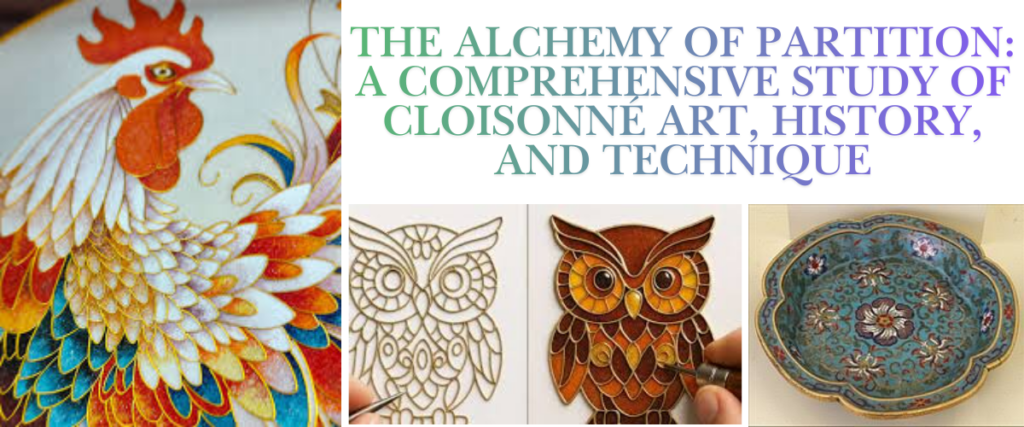
The history of decorative arts is punctuated by efforts to capture the fleeting brilliance of light within the permanence of metal and stone. Among these endeavours, cloisonné stands as perhaps the most sophisticated synthesis of metallurgy, glasswork, and chemistry. The term cloisonné, derived from the French word cloison, meaning “partition” or “compartment,” refers to an ancient technique for decorating metalwork objects with colored vitreous enamel or inlays of cut gemstones and glass.1 At its most fundamental level, the art form involves the creation of delicate metal enclosures upon a substrate—typically copper, silver, or gold—which are then filled with colored material and fused through intense heat.4 The resulting surface is a luminous mosaic where the structural metal wires remain visible, acting both as boundaries for the colour and as an integral part of the aesthetic design.1
This technique has traversed three millennia of human history, migrating across the ancient Near East, the Mediterranean, the Byzantine Empire, and into the Far East via the Silk Road.2 Each culture that adopted the craft—from the goldsmiths of Mycenae to the imperial masters of the Ming Dynasty and the Meiji-era revolutionaries in Japan—refined the process to reflect its unique philosophical and aesthetic priorities.7 To understand cloisonné is to understand a global narrative of technological exchange, where the quest to simulate precious gems eventually led to a medium that surpassed its inspiration in both versatility and brilliance.1
The Genesis of Partitioned Ornament: From Antiquity to the Mediterranean
The conceptual origins of cloisonné precede the widespread use of vitreous enamel. In the second millennium BCE, the technique served as a mechanical solution for securing gemstones to jewellery. Ancient Egyptian and Mycenaean craftsmen practised cloisonné inlay, where semi-precious stones like lapis lazuli, turquoise, and carnelian were meticulously cut to fit within gold cells.1 Archaeological excavations in 1952 at Kouklia, Cyprus, provided a definitive chronological marker for the technique’s early development, unearthing six gold and cloisonné rings in a Mycenaean tomb dating back to the 13th century BCE.2 These artifacts represent some of the earliest documented instances of metal partitions used to contain decorative material, a practice that would later evolve into the fusion of glass to metal.2
In the ancient Near East, the earliest prototypes of proper enamelling began to appear as artisans sought easier ways to imitate the labour-intensive setting of gems.1 By grinding colored glass into powder and melting it within metal compartments, they discovered they could achieve a wider array of hues and more complex geometries than natural stones allowed.1 This transition from stone to glass marked a profound shift in the history of materials, as it required a nascent understanding of thermal expansion and the chemistry of metallic oxides.5
| Historical Period | Region | Primary Characteristics | Material Focus |
| 13th Century BCE | Mycenae/Cyprus | Gold rings with stone/enamel partitions | Gold and Gemstones 2 |
| 3rd Millennium BCE | Mesopotamia | Early stone inlays in metal cells | Lapis Lazuli, Gold 13 |
| Ancient Egypt | Nile Valley | Pectorals and amulets with complex inlays | Gold, Turquoise, Glass 9 |
| 7th Century BCE | Greece/Mediterranean | Development of vitreous enamelling | Vitreous Enamel 2 |
During the Hellenistic and Roman periods, cloisonné remained largely a medium for small-scale jewellery and clothing fittings.1 The thick-walled cloisons of this era typically featured geometric or schematic designs, reflecting the limitations of early kiln technology and the difficulty of producing thin, uniform metal strips.1 However, these early works established the structural logic that would define the art form for the next two thousand years: the metal wire as both the “skeleton” and the “drawing” of the piece.1
The Byzantine Zenith and the Theology of Light
The Byzantine Empire (7th–11th centuries) represents the first true “Golden Age” of cloisonné enamel.9 In the hands of Byzantine masters, the technique was elevated from a decorative craft to a profound expression of religious and imperial ideology.9 The use of high-carat gold as a substrate was not merely a display of wealth but a theological choice; the reflective quality of the gold, seen through translucent layers of enamel, was intended to evoke the divine light of the heavens.1
Byzantine artisans developed two primary techniques that are still identified by their German names in modern scholarship: Vollschmelz and Senkschmelz.1
Vollschmelz: The Full Melt
In the Vollschmelz technique, the entirety of a gold base plate is covered in enamel.1 The edges of the plate are turned up to form a shallow reservoir, and gold wires are soldered onto the base to create the intricate design.1 Because the entire surface is filled with glass, the resulting object has a saturated, border-to-border intensity of colour.1 This method was frequently used for small, portable icons and jewellery that required a high degree of visual impact.1
Senkschmelz: The Sunk Enamel
The Senkschmelz technique, by contrast, involved creating a recessed area within a thicker gold plate, essentially sinking the cloisonné work into the metal.1 The surrounding un-enamelled gold remained visible, providing a lustrous frame for the central image.1 This method allowed for greater structural integrity and was often used in larger, more complex religious objects, such as the 9th-century Fieschi Morgan Staurotheke, a relic container that showcased the peak of Byzantine craftsmanship.9
The masterpiece of this era is arguably the Monomachus Crown, an 11th-century treasure believed to have been commissioned for Emperor Constantine IX Monomachus.9 The crown consists of seven gold plates decorated with miniature portraits of the imperial family, saints, and revellers.9 These portraits were rendered with such fine wirework that the facial features and garments possess a painterly detail, demonstrating a mastery of the medium that would not be rivalled in the West for centuries.9
The Transmission of Technique: The Silk Road and Islamic Influence
The migration of cloisonné from the Mediterranean to the Far East is a narrative of cultural hybridisation facilitated by the Mongol Empire. While China had a long history of ceramic and bronze production, cloisonné was a late arrival, appearing significantly during the Yuan Dynasty (1271–1368).2 The technique was likely introduced by Islamic artisans from the Middle East and Persia, who were relocated to China under Mongol rule.11
This foreign pedigree is reflected in the early Chinese names for the craft. The scholar Cao Zhao, writing in his 1388 treatise Gegu Yaolun (Guide to the Study of Antiquities), referred to cloisonné as dashi yao (Muslim ware).2 Cao Zhao, representative of the restrained scholar-official class, famously dismissed the art form as “suitable only for lady’s chambers,” finding its flamboyant colours and intricate metalwork too showy for the austere tastes of the Chinese elite.2 Despite this initial scepticism, the vibrant aesthetic of cloisonné eventually found favour at the imperial court, particularly because its “flamboyant splendour” was deemed appropriate for the furnishing of temples and palaces.15
The Mongol Melting Pot
Under the Mongol Yuan rulers, China became a melting pot of Central Asian, Islamic, and traditional Han Chinese artistic traditions.17 The introduction of cobalt from the Middle East, known as huihuiqing or “Muslim blue,” not only transformed Chinese porcelain but also provided the essential pigment for the turquoise and deep blue grounds of Chinese cloisonné.2 This period saw the adaptation of Middle Eastern metal vessel shapes—such as the meiping vase and the tripod incense burner—into the Chinese repertoire.11
| Dynasty | Role of Cloisonné | Key Developments | Source of Influence |
| Yuan (1271–1368) | Introduction | Arrival of Islamic artisans; early “Dashi ware” | Middle East/Persia 2 |
| Ming (1368–1644) | Perfection | Development of Jingtailan; the golden age of production | Imperial Patronage 2 |
| Qing (1644–1912) | Expansion | Integration of European techniques; diverse regional styles | Jesuit Missions/Europe 10 |
The Ming Dynasty (1368–1644) represents the peak of Chinese cloisonné development, an era so significant that the craft is often synonymous with the reign of the Jingtai Emperor (1449–1457).2 Known in China as Jingtailan (Jingtai Blue), the work of this period is characterised by a deep, luminous turquoise background and intricate floral motifs, particularly the lotus.2 The technical mastery achieved during the Ming era allowed for larger objects, such as palace-sized incense burners and vases, which utilised heavier bronze or copper bodies to withstand the multiple firings required for rich colour depth.10
The Japanese Renaissance: Shippo-yaki and the Seven Treasures
While cloisonné techniques reached Japan as early as the 7th century, the art form nearly vanished for several centuries, relegated to small-scale sword fittings and temple decorations.7 The modern era of Japanese cloisonné began in the 1830s with Tsunekichi Kaji, a former samurai from Nagoya who meticulously reverse-engineered a Chinese cloisonné plate to rediscover the process.7 Kaji’s success transformed Nagoya into a centre of enamel production, and the craft came to be known as shippo-yaki.7
The term shippo translates to “Seven Treasures,” a reference to the Buddhist Lotus Sutra, which lists gold, silver, pearl, carnelian, agate, seashell, and lapis lazuli as symbols of sacred beauty.7 Japanese artisans aimed to create works that rivalled these jewels in lustre and clarity.7 During the Meiji Restoration (1868–1912), the Japanese government actively promoted shippo-yaki as a prestige export to showcase Japan’s modernisation and artistic refinement to the Western world.7
The Technical Duel: Yasuyuki and Sosuke
The “Golden Age” of Japanese enamels (1890–1910) was dominated by two master artists: Namikawa Yasuyuki of Kyoto and Namikawa Sosuke of Tokyo.25 Despite sharing a surname (though they were not related), their artistic philosophies represented two distinct branches of the medium.26
Namikawa Yasuyuki remained a master of the “wired” tradition (yuusen shippo).4 His work is characterised by incredibly fine, hair-like silver or gold wires that define intricate landscapes, birds, and floral designs.21 Yasuyuki’s greatest innovation was the development of a transparent black glaze that gave his pieces an unparalleled depth and a mirror-like finish.25 He often hosted international visitors, including the writer Rudyard Kipling, who marvelled at the hundreds of hours required to polish a single small vase.25
Namikawa Sosuke, conversely, revolutionised the “wireless” technique (musen shippo).4 By using temporary wires that were removed before the final firing, or by applying enamel in a way that allowed colours to bleed into one another, Sosuke achieved a painterly effect that mimicked traditional Japanese ink wash paintings.26 His work minimised the visible structure of the cloisons to create ethereal gradients and soft, misty backgrounds that were previously impossible in the medium of glass.26
| Feature | Chinese Jingtailan | Japanese Shippo-yaki |
| Metal Base | Heavy bronze or copper 21 | Lightweight copper or silver 7 |
| Ground Color | Predominantly turquoise/blue 11 | Black, deep blue, or soft white 21 |
| Motifs | Formal lotus scrolls, dragons 11 | Naturalistic birds, flowers, landscapes 21 |
| Aesthetic Goal | Flamboyant, imperial splendor 15 | Painterly, minimalistic, elegant 21 |
| Surface | Often shows tiny pits/texture 21 | Mirror-smooth, flawless finish 21 |
The Mechanics of Mastery: Materials and Chemistry
The creation of a cloisonné object is a labour-intensive process that balances the structural rigidity of metal with the brittle fluidity of glass. Every stage of production is fraught with the risk of failure, from the warping of the metal base to the cracking of the enamel during cooling.6
The Metallurgy of the Base
The choice of base metal is critical for the success of the enamelling process. Copper is the most common material due to its malleability and relatively low cost, but gold and silver are preferred for high-end jewellery and imperial commissions because they do not tarnish and provide a superior reflective surface for transparent enamels.1
A significant challenge in metallurgy is the “coefficient of thermal expansion.” Different metals expand and contract at different rates when heated.12 Silver, for instance, has the highest expansion rate among the common base metals, which often leads to the enamel cracking or chipping off if the piece is not properly balanced with “counter-enamel” on the reverse side.12 Gold, having a lower expansion rate and higher ductility, was the preferred choice in antiquity for this reason.12
The Chemistry of Vitreous Enamel
Vitreous enamel is essentially a specialised form of glass.5 It is composed of a “frit”—a mixture of silica (from quartz), niter, and lead oxide—which is melted together and then ground into a fine powder.1 The colours are achieved by adding specific metallic oxides to the molten glass:
- Cobalt Oxide: Produces deep blues.5
- Copper Oxide: Produces greens and turquoise.5
- Manganese: Produces violets and purples.5
- Iron Oxide: Produces yellows and browns.5
The powder must be washed meticulously in distilled water to remove impurities that could cause discolouration or cloudiness during firing.1 Once prepared, the enamel is made into a paste and applied to the metal cloisons using fine brushes or spatulas.1
The Firing Cycle
Cloisonné objects are fired in a kiln at temperatures typically ranging from to  .4 Because the glass powder shrinks as it melts—much like sugar melting in an oven—the compartments must be filled and fired multiple times.1 For high-end Meiji pieces, it was not uncommon for an object to undergo 10 to 35 separate firing cycles to achieve the desired depth of colour and ensure that the enamel reached the top of the cloisonné wires.1
A Taxonomy of Global Enamelling Techniques
Beyond the traditional wired cloisonné, the world of enamelling includes several specialised techniques that offer different visual effects and require varying levels of artisan skill.13
Champlevé: The Recessed Method
In champlevé (French for “raised field”), the design is not built up with wires but is instead carved, etched, or cast directly into the metal surface.34 These recessed areas are filled with enamel and fired.34 Because the base metal must be thick enough to accommodate carving, champlevé objects are significantly heavier than cloisonné objects of the same size.36 This technique was favoured in medieval Europe, particularly in the Limoges region of France, for creating durable religious artifacts like reliquaries and chalices.1
Plique-à-jour: Stained Glass in Miniature
Plique-à-jour (French for “open to daylight”) is arguably the most difficult of all enamelling techniques.34 It creates a translucent design without a metal backing, functioning like miniature stained glass.13 In the Japanese tradition (shoutai shippo), this is often achieved by applying enamel to a copper base that is subsequently dissolved in acid after firing, leaving only the silver wires and the glass.4 This technique was a hallmark of the Art Nouveau movement, famously used by René Lalique to create ethereal jewellery inspired by nature.9
Basse-taille and Guilloché
Basse-taille involves enamelling over a metal base that has been decorated with low-relief engraving or chasing.13 The translucent enamel allows the underlying pattern to shine through, creating a sense of depth and movement.5 Guilloché is a subset of this technique, where a precise, repetitive geometric pattern is machine-engraved onto the metal (often silver or gold) before being covered with transparent enamel.34 This technique is most famously associated with the House of Fabergé, specifically the imperial eggs and snuff boxes produced for the Russian Tsars.9
| Technique | Method | Visual Effect | Primary Association |
| Cloisonné | Wires on the surface | Mosaic with wire outlines | China/Japan 37 |
| Champlevé | Carved recesses | Bold contrast, heavy base | Medieval Europe 37 |
| Plique-à-jour | No backing | Stained-glass transparency | Art Nouveau 38 |
| Moriage | Layered enamel | Three-dimensional relief | Meiji Japan 4 |
| Grisaille | Painted white on black | Monochromatic gradient | Renaissance France 13 |
The Connoisseur’s Perspective: Authentication and the Market
For the modern collector, the world of cloisonné is a minefield of mass-produced replicas and industrial “cold enamel” imitations. Authenticating a piece requires a keen eye for material behaviour and the subtle signatures of hand-craftsmanship.21
Distinguishing Vitreous Enamel from Resin
The most important distinction for a collector is between true high-fire vitreous enamel and modern “cold enamel,” which is typically a colored epoxy resin.5
- Surface Hardness: True enamel is glass; it is hard, chemically inert, and scratch-resistant.5 Resin is softer and can be scratched with a pin or even a fingernail in some cases.5
- Optical Depth: Vitreous enamel has a depth and brilliance that resin cannot replicate.5 Translucent glass enamels reveal the texture of the metal beneath, whereas resin tends to look flat or plasticky.5
- The Tap Test: Tapping a piece of vitreous enamel with a fingernail produces a sharp, metallic “clink” characteristic of glass on metal.34 Resin produces a duller, more plastic thud.34
Signatures of Age: Pitting and Patina
Ironically, perfection is not always a sign of value in older Chinese pieces. On Ming and early Qing cloisonné, one often sees “pitting”—tiny holes in the enamel surface.21 These are bubbles of air or impurities that pushed through the molten glass during the primitive firing process.21 While modern workshops have better kiln control and fewer pits, scattered pitting is an expected and even desired trait in authentic antique Chinese work.21
Patina on the exposed metal rims (usually gilt-bronze or brass) should feel “bonded” to the metal.21 Collectors should be wary of “theatrical patina”—sudden dark patches that look forced or painted on, which are often used to age modern tourist items.21 Furthermore, authentic hand-placed wires will show slight irregularities in placement, whereas machine-stamped cloisons look “mechanically perfect” and “lazy” in their execution.21
Market Trends and Auction Values (2024–2025)
The market for cloisonné in 2025 is characterised by a “Great Wealth Transfer,” where a new generation of collectors is entering the space.42 These younger buyers are increasingly drawn to “emerging art” and pieces that offer a unique narrative or cultural identity.42 However, the top end of the market for rare antiques remains exceptionally strong.42
| Auction Highlight | Description | Sale Price (Est./Actual) | Date |
| Ming Dynasty Box | Rare 15th-century box found in an attic | £288,000 ($358,000) 45 | Recent (Dreweatts) |
| Ming Fanghu Vase | 17th-century cloisonné and gilt-bronze | $25,000 44 | Spring 2025 |
| Meiji Silver Vase | Kin’unken of Kyoto, late 19th c. | Approx. £3,570 46 | Recent (Bonhams) |
| Qianlong Jade Vase | 18th-century white jade (for context) | $20,000 44 | Spring 2025 |
The 2025 Art Market Report indicates that while total global sales contracted by 12% in 2024, the “mid-to-lower price segment” (artworks under $5,000) saw a 3% rise in transactions, driven by entry-level collectors seeking accessible pieces of history.42 For cloisonné, this translates to a robust market for decent 19th-century export wares, which often sell in the low hundreds of pounds, while signed Meiji masterpieces continue to be treated as high-value specialist assets.21
Ethics and Preservation: Caring for a Glass Legacy
Cloisonné is a remarkably durable medium—vitreous enamel is resistant to UV light, climate changes, and corrosion.5 However, its glass nature makes it highly susceptible to physical trauma.5
Professional Care Standards
- Cleaning: The surface should be dusted with a very soft, lint-free cloth.31 Plain water can be used for light polishing, but the object should never be soaked, as small voids or pits in the enamel could absorb liquid and cause internal damage or oxidation of the base metal over time.47
- Chemical Hazards: Artisans and collectors must avoid all chemical cleaners and abrasives, which can etch the glass and permanently dull its lustre.5
- Storage: Cloisonné items should be stored in separate padded compartments.47 When travelling, a jewellery roll or travel organiser is essential to prevent the delicate surface from scratching against other pieces.47
- Repair: If the enamel is cracked or chipped, professional restoration is required.47 This is a specialised field, and amateur attempts to “glue” enamel can devalue the piece and complicate future professional repairs.47
Beyond physical care, there is an emerging discussion around the sustainability and ethics of the craft. Modern cloisonné is often praised as an “eco-friendly” option because it relies on natural minerals and traditional techniques with minimal environmental impact compared to mass-produced industrial jewellery.6 However, the use of lead in traditional vitreous enamel remains a point of technical and regulatory discussion, leading many modern artisans to seek lead-free alternatives that maintain the brilliance of the historical recipes.1
Conclusion: The Enduring Brilliance of Partitioned Glass
Cloisonné art is more than a decorative technique; it is a material record of human ambition and the global exchange of ideas. From its origins as a mechanical substitute for gemstones in the ancient Near East to its spiritual zenith in the Byzantine Empire, and its final refinement into a painterly medium in Meiji-era Japan, cloisonné has served as a bridge between cultures.1 It is a craft that demands an almost meditative patience—where a single small vase may represent months of labour and dozens of fires.20
As we look toward the future of the art market and the continued revival of heritage crafts, cloisonné remains a symbol of “artistry and craftsmanship”.6 In an era of digital acceleration and mass production, the “flamboyant splendour” of a hand-wired enamel piece offers a tangible connection to the history of human touch and the alchemy of fire.6 Whether held in a museum collection or worn as a contemporary pendant, cloisonné continues to capture the imagination, preserving the vibrant “blue” of the Ming Dynasty and the “seven treasures” of the Lotus Sutra for generations to come.7
Disclaimer
The information provided in this article is intended for educational and research purposes only. While every effort has been made to ensure the accuracy of the historical and technical data, the art market is subject to significant volatility, and the value of individual pieces can vary based on condition, provenance, and attribution. The identification of antique enamels involves subjective judgment and should be performed by professional appraisers. Furthermore, the technical processes described—including the handling of molten glass, high-temperature kilns, and chemical acids—involve inherent safety risks and should not be attempted by untrained individuals without professional supervision. The author and publisher assume no liability for any damage or loss resulting from the use of the information contained herein.
Reference
- Cloisonné – Wikipedia, accessed on January 31, 2026, https://en.wikipedia.org/wiki/Cloisonn%C3%A9
- The Complex Journey of Cloisonne: From Greece to France to Imperial Ch – Pearl River Mart, accessed on January 31, 2026, https://pearlriver.com/blogs/blog/the-complex-journey-of-cloisonne-from-greece-to-france-to-imperial-china
- COLLECTIONS: CLOISONNE – – Nena Ivon, accessed on January 31, 2026, https://nenasnotes.com/2017/02/02/collections-cloisonne/
- Cloisonné Enamel: A Comprehensive Guide to Techniques and …, accessed on January 31, 2026, https://en.kogei-japonica.com/media/crafts/howto-cloisonne/
- Is Cloisonné Jewelry Expensive? Buying Guide & Craftsmanship Secrets, accessed on January 31, 2026, https://www.zolanjewelry.com/blogs/news/cloisonne-enamel-jewelry-guide
- The Art of Cloisonné Enamel in Jewellery: A Timeless Craft – Jenti Forest, accessed on January 31, 2026, https://www.jentiforest.com/post/the-art-of-cloisonn%C3%A9-enamel-in-jewellery-a-timeless-craft
- Japanese Ceramics: The Alluring Wares of Shippo Yaki – Sakuraco, accessed on January 31, 2026, https://sakura.co/blog/japanese-ceramics-the-alluring-wares-of-shippo-yaki
- Exploring the Artistic Journey of Cloisonne Beads for Jewelry Making – BeadsFindingDepot, accessed on January 31, 2026, https://www.beadsfindingdepot.com/blogs/news/exploring-the-artistic-journey-of-cloisonne-beads-for-jewelry-making
- The Elegance of Enamel: Cloisonné Treasures – Invaluable, accessed on January 31, 2026, https://www.invaluable.com/blog/the-elegance-of-enamel-cloisonne-treasures/
- The Wonder of Cloisonné – Fire Mountain Gems, accessed on January 31, 2026, https://www.firemountaingems.com/learn/categories/jewelry-medium/metalworking/how-tos-on-metalworking/5546-article.html
- Symbolism in Cloisonné – National Museum of Asian Art – Smithsonian Institution, accessed on January 31, 2026, https://asia-archive.si.edu/learn/for-educators/teaching-china-with-the-smithsonian/lesson-plans/symbolism-in-cloisonne/
- Cloisonne Primer – History of Cloisonne Technique – Ganoksin Jewelry Making Community, accessed on January 31, 2026, https://www.ganoksin.com/article/history-cloisonne-technique/
- Vitreous enamel – Wikipedia, accessed on January 31, 2026, https://en.wikipedia.org/wiki/Vitreous_enamel
- Ricky Frank Enamels Home – rickyfrank.com, accessed on January 31, 2026, https://www.rickyfrank.com/home1.html
- Chinese Cloisonné – The Metropolitan Museum of Art, accessed on January 31, 2026, https://www.metmuseum.org/essays/chinese-cloisonne
- Symbolism in Cloisonné, accessed on January 31, 2026, https://asia-archive.si.edu/wp-content/uploads/2020/06/LP3-Symbolism-in-Cloisonne%CC%81-FA2-1.pdf
- The Yuan dynasty: unique porcelain expertise – Gauchet Art Asiatique, accessed on January 31, 2026, https://www.gauchetexpert.com/en/post/the-yuan-dynasty-unique-porcelain-expertise
- Muslim Blue, Chinese White: Islamic Calligraphy on Ming Blue-and-white Porcelain, accessed on January 31, 2026, https://www.orientations.com.hk/highlights/hwlush38moqfp7lhum7klblb2asssj
- Out of the Blue: Rethinking Early Chinese Cloisonné Enamel – Arts of Asia, accessed on January 31, 2026, https://artsofasia.com/out-of-the-blue-rethinking-early-chinese-cloisonne-enamel/
- Cloisonné Enamel Jewelry: The Luxurious Art of Copper and Fire, accessed on January 31, 2026, https://www.zolanjewelry.com/blogs/news/cloisonne-enamel-jewelry-luxurious-art-copper-fire
- How To Identify And Value Chinese And Japanese Cloisonne – Taliesin Antiques, accessed on January 31, 2026, https://www.taliesinantiques.com/en-GB/how-to-identify-and-value-chinese-and-japanese-cloisonne/blog_10021
- History of Cloisonné | 加藤七宝製作所ウェブサイト, accessed on January 31, 2026, https://katoshippo.com/page/history-of-cloisonne_e
- accessed on January 31, 2026, https://sakura.co/blog/japanese-ceramics-the-alluring-wares-of-shippo-yaki#:~:text=The%20word%20shippo%20means%20%E2%80%9Cseven,piece%20glows%20like%20a%20jewel.
- GLOSSARY: Shippo – Gotheborg.com, accessed on January 31, 2026, https://www.gotheborg.com/glossary/shippo.shtml
- Artists + Designers | Toomey & Co. Auctioneers, accessed on January 31, 2026, https://www.toomeyco.com/artists/namikawa-yasuyuki/about
- Cloisonné enamel – Ashmolean − Eastern Art Online, Yousef …, accessed on January 31, 2026, https://jameelcentre.ashmolean.org/collection/6/659/666
- Namikawa Yasuyuki – Wikipedia, accessed on January 31, 2026, https://en.wikipedia.org/wiki/Namikawa_Yasuyuki
- Who is Namikawa Yasuyuki ? Legendary Meiji Cloisonne Ware Artist – History,Characteristics,and Locations Where His Works are Sold – 銀座 真生堂, accessed on January 31, 2026, https://ginza-shinseido.com/blog/1849/
- Japanese Cloisonné: Polished to Perfection – Asian Art Newspaper, accessed on January 31, 2026, https://asianartnewspaper.com/japanese-cloisonne-golden-age/
- Namikawa Yasuyuki: Japan’s Greatest Cloisonne Artist – Revere Auctions, accessed on January 31, 2026, https://www.revereauctions.com/namikawa-yasuyuki-the-golden-age-of-japanese-cloisonne-revealed-in-a-wisteria-vase/
- How to Choose the Best Cloisonne Vase: A Complete Buying Guide – Plant Care, accessed on January 31, 2026, https://plantin.alibaba.com/buyingguides/cloisonne-vase
- Georgian Cloisonne Enamel – Ganoksin Jewelry Making Community, accessed on January 31, 2026, https://www.ganoksin.com/article/georgian-cloisonne-enamel/
- The Basics of Making Your Own Cloisonne, accessed on January 31, 2026, https://jewelrymakingjournal.com/the-basics-of-making-your-own-cloisonne/
- Antique Enamel: A Buyer’s Guide – Mayfair Gallery, accessed on January 31, 2026, https://www.mayfairgallery.com/blog/antique-enamel-buyers-guide/
- How is cloisonne made? – julieglassman.com, accessed on January 31, 2026, https://julieglassman.com/pages/what-is-cloisonne
- How to Identify Antique Enamels, accessed on January 31, 2026, https://www.antiquetrader.com/collecting-101/how-to-identify-antique-enamels
- Cloisonne vs Champleve: What’s the Difference Between These Enameling Techniques? – Canonbury Antiques, accessed on January 31, 2026, https://canonburyantiques.com/kbd/Cloisonne-vs-Champleve-Whats-the-Difference-Between-These-Enameling-Techniques/
- Different Enamelling Techniques – Mozeris Fine Antiques, accessed on January 31, 2026, https://www.mozerisfineantiques.com/blogs/different-enamelling-techniques-for-jewellery
- A Gem of an Enamel | Cleveland Museum of Art, accessed on January 31, 2026, https://www.clevelandart.org/articles/gem-enamel
- Japanese cloisonné manufacturing technique – Arts & Crafts Stack Exchange, accessed on January 31, 2026, https://crafts.stackexchange.com/questions/13402/japanese-cloisonn%C3%A9-manufacturing-technique
- Gesswein Colorit enameling unit – Jewelry Discussion – Ganoksin Orchid, accessed on January 31, 2026, https://orchid.ganoksin.com/t/gesswein-colorit-enameling-unit/15094
- 2025 Art Market Trends: Luxury, Collectors & Change, accessed on January 31, 2026, https://worldluxurychamber.com/2025-art-market-trends-luxury-collectors/
- Art Market Trends 2025 | Artsy, accessed on January 31, 2026, https://www.artsy.net/article/artsy-editorial-art-market-trends-2025
- 2025 in Review: Asian Art – Waddingtons.ca, accessed on January 31, 2026, https://www.waddingtons.ca/2025-in-review-asian-art/
- A Rare Ming Dynasty Cloisonné Box, Which Languished for Decades in a Dusty Attic … – Artnet News, accessed on January 31, 2026, https://news.artnet.com/market/rare-ming-dynasty-cloisonne-box-attic-discovery-auction-2305463
- Fine Japanese Art Auction – Friday, 5 December 2025 by zacke1664 – Issuu, accessed on January 31, 2026, https://issuu.com/zacke1644/docs/fine_japanese_art_auction_-_friday_5_december_202
- Guide to Cloisonné Jewelry: Know Before You Buy | LoveToKnow, accessed on January 31, 2026, https://www.lovetoknow.com/life/style/about-cloisonne-jewelry